You don’t need a gym membership, a big room or a rack of equipment to get fitter. You need a clear plan, a small patch of floor and a way of starting that doesn’t wipe you out in week one.
This guide covers how to work out at home for beginners: how much activity to aim for, which movements to learn first, how hard to push, and a simple four-week plan to get going. If you have a health condition, an injury or any doubts, check with a doctor before you start.
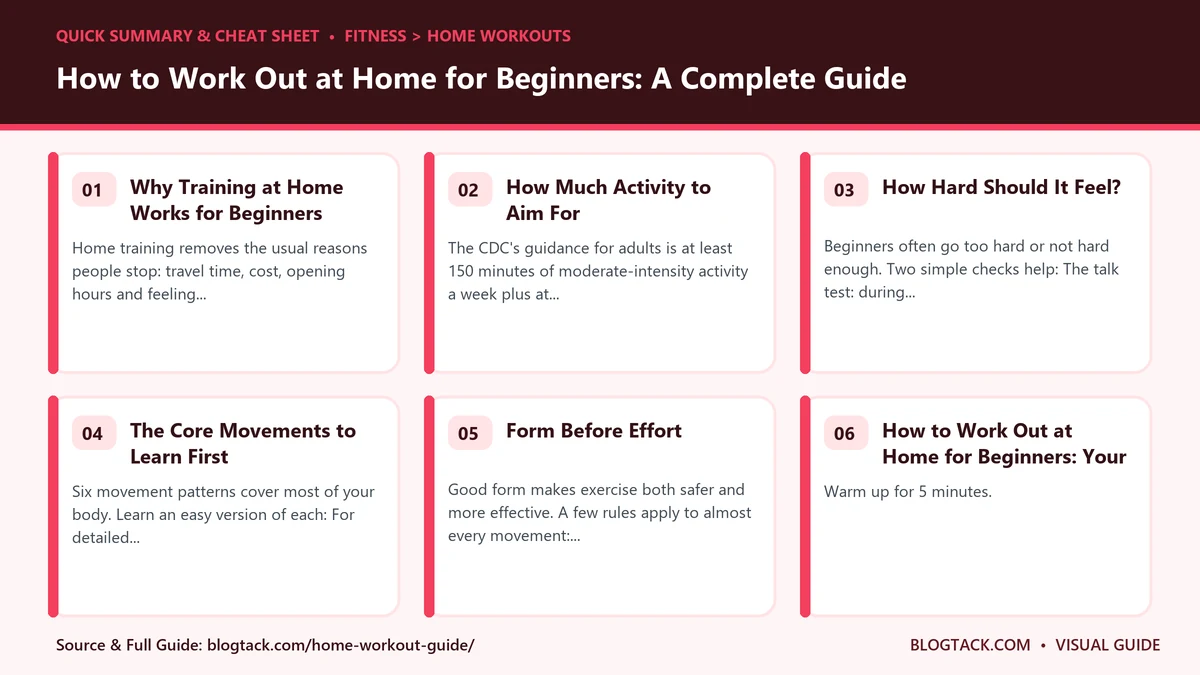
Why Training at Home Works for Beginners
Home training removes the usual reasons people stop: travel time, cost, opening hours and feeling watched. When the barrier to starting is just “roll out a mat,” you’re more likely to show up on a busy day. And showing up, week after week, is what builds fitness.
Your own bodyweight is enough resistance to build real strength at first. Squats, push-ups, lunges and planks challenge most beginners plenty, and each one can be made easier or harder as you improve.
How Much Activity to Aim For
The CDC’s guidance for adults is at least 150 minutes of moderate-intensity activity a week plus at least 2 days of muscle-strengthening work (CDC). That can be split into shorter sessions spread through the week.
Treat that as a direction, not a starting requirement. If you’re doing very little now, any amount more is a step forward. Build toward it over weeks and months.
| Type of activity | Weekly goal (adults) | Home examples |
|---|---|---|
| Moderate aerobic (“cardio”) | 150 minutes, split however you like | Brisk marching, low-impact cardio circuits, dancing |
| Muscle-strengthening | 2 or more days, all major muscle groups | Squats, push-up variations, glute bridges, rows with a band |
| Flexibility and mobility | Not a set target; most days is helpful | Light stretches, mobility flows |
How Hard Should It Feel?
Beginners often go too hard or not hard enough. Two simple checks help:
- The talk test: during moderate activity you can talk but not sing. During vigorous activity you can only say a few words before pausing for breath (CDC).
- A 0 to 10 effort scale: 0 is sitting still, 10 is all-out. The CDC describes moderate effort as about 5 or 6 and vigorous as starting around 7 or 8.
For your first weeks, aim for moderate effort. Finish sessions feeling like you could have done a bit more. That’s the sweet spot for building a habit without burning out—especially when paired with a balanced diet and solid hydration basics.
The Core Movements to Learn First
Six movement patterns cover most of your body. Learn an easy version of each:
| Pattern | Beginner version | Muscles worked |
|---|---|---|
| Squat | Sit-to-stand from a chair | Thighs, hips, glutes |
| Push | Wall or countertop push-up | Chest, shoulders, arms |
| Hinge | Glute bridge | Glutes, hamstrings, lower back |
| Lunge | Supported split squat holding a wall | Legs, balance |
| Core | Forearm plank on knees or dead bug | Abdominals, trunk |
| Pull | Resistance band row, or towel row against a door frame (only if stable) | Upper back, arms |
For detailed progressions, see our guide to bodyweight exercises for strength.
Form Before Effort
Good form makes exercise both safer and more effective. A few rules apply to almost every movement:
- Move slowly enough that you control both the lift and the lowering.
- Keep a neutral spine, neither rounded nor arched hard.
- Breathe steadily. The National Institute on Aging suggests breathing out as you lift or push and in as you relax, and not holding your breath (NIA).
- Stop a set when your form starts to slip, not when you can’t move at all.
Filming yourself from the side, or using a mirror, helps you spot problems early.
How to Work Out at Home for Beginners: Your First Session
- Warm up for 5 minutes. March in place, roll your shoulders, do easy leg swings. See how to warm up before a workout.
- Do one round of the six movements. 8 to 10 slow reps each (or a 15 to 20 second hold for planks).
- Rest 30 to 60 seconds between exercises.
- Repeat for a second round only if you feel good.
- Cool down for 3 to 5 minutes with easy walking and a few gentle stretches.
That’s it. Total time: roughly 20 to 25 minutes.
A Simple 4-Week Starter Plan
| Week | Strength days | Cardio days | Notes |
|---|---|---|---|
| 1 | 2 days: 1 to 2 rounds of the six movements | 2 days: 10 to 15 minutes brisk marching or low-impact cardio | Learn the movements; keep effort moderate |
| 2 | 2 days: 2 rounds | 2 to 3 days: 15 to 20 minutes | Add a few reps only if form is solid |
| 3 | 2 to 3 days: 2 to 3 rounds | 3 days: 20 minutes | Try one harder version of an easy exercise |
| 4 | 2 to 3 days: 3 rounds | 3 days: 20 to 25 minutes | Review how you feel; keep at least 1 to 2 full rest days |
This is an example, not a prescription. If a week feels like too much, repeat it. Progress isn’t a race. For building your own schedule, see how to build a workout routine at home.
What Equipment Do You Need?
To start: nothing beyond comfortable clothes, supportive shoes if you’ll be stepping or jumping, and a non-slip surface. A mat makes floor work more comfortable. Resistance bands are a useful, low-cost first purchase when you’re ready. See how much equipment you need for home workouts.
Rest Is Part of the Plan
Muscles adapt between sessions, not during them. Leave at least a day between hard strength sessions for the same muscle groups, sleep well and expect some mild soreness when you start. Read our guide to rest and recovery to learn what’s normal and what isn’t.
Know When to Stop
Stop exercising and seek medical help if you have chest pain or pressure, severe shortness of breath, dizziness, fainting, or sharp pain in a joint. Mild muscle fatigue is normal; sharp or worsening pain isn’t. The CDC notes that moderate activity is safe for most people but that some should talk to a doctor first, especially with heart conditions or other chronic health issues (CDC).
Making It Stick
- Schedule it like an appointment, at a time you can protect.
- Lower the bar on hard days. Ten minutes still counts.
- Track sessions, not just results. A tick on a calendar is motivating.
- Pick movements you don’t hate. Enjoyment predicts consistency.
More ideas in how to stay motivated to work out at home.
Setting Up Your Space
You don’t need a dedicated room. A space roughly the length of your body plus arm’s reach on each side covers almost every beginner exercise. Before each session:
- Clear furniture corners, toys, cables and rugs that slide.
- Check the floor isn’t slippery; a mat or bare floor with good shoes works.
- Make sure ceiling fans and light fittings are well out of reach if you raise your arms.
- Keep water nearby and the room reasonably ventilated.
If space is very tight, see our guide to home workouts for small spaces.
Adapting the Plan to You
Everyone starts from a different place. A few common adjustments:
| If you… | Try this |
|---|---|
| Find floor exercises hard to get up from | Use standing or chair-based versions first |
| Have sore knees | Reduce squat depth; choose low-impact cardio |
| Feel out of breath quickly | Shorter work periods, longer rests, steady pace |
| Find everything too easy | Slow the tempo, add reps, or try harder variations |
| Have very little time | Two 10-minute sessions instead of one longer one |
None of these are “lesser” workouts. They’re the right workout for you right now.
Common Beginner Questions
How soon will I notice a difference?
Many people feel better (more energy, better sleep, easier stairs) within a few weeks. Visible changes take longer and vary a lot from person to person.
Should I work out every day?
Light movement every day is fine. Hard strength sessions for the same muscles need recovery time between them.
Is it OK to feel sore?
Mild soreness a day or two after a new workout is common. Sharp pain, swelling or soreness that lasts many days is a sign to ease off and possibly get it checked.
Do I need to stretch before working out?
A dynamic warm-up is more useful before exercise. Save longer, held stretches for after your workout.
What if I miss a week?
Start again where you’re comfortable. One missed week doesn’t erase your progress, and an easy restart is better than trying to make up for lost time.
The Bottom Line
Learning how to work out at home for beginners comes down to a few habits: start with simple movements, keep effort moderate at first, focus on form, rest between hard sessions and build gradually toward the recommended weekly activity. Consistency over months matters far more than any single workout.
This article is for general informational and educational purposes only and is not medical or professional fitness advice. Exercise carries inherent risks. Consult a doctor or qualified health professional before starting any new exercise program, especially if you have any health conditions, injuries, or concerns.