Many people can follow a workout plan for two weeks. The harder part is month three, when the novelty has worn off, work gets busy and the plan starts to feel like a chore. A routine that lasts is designed for that moment from the start.
This guide explains how to build a workout routine at home step by step: where to start, what to include, how to schedule it, how to progress and what to do when things go off track.
Step 1: Find Your Starting Point
Before choosing a plan, take an honest snapshot of where you are now:
| Question | Why it matters |
|---|---|
| How active are you in a typical week? | Sets how much to add at first |
| Any injuries, pain or health conditions? | Decides which movements to adapt and whether to see a doctor first |
| How many days could you realistically train? | Shapes the weekly structure |
| How long can a session be on a normal day? | Sets session length |
| What do you enjoy, or at least not hate? | Predicts whether you’ll keep going |
A simple baseline test helps too: how many controlled squats and wall or incline push-ups you can do, how long you can hold a plank, and how you feel after 10 minutes of brisk marching. Write it down to compare in a month.
Step 2: Decide What Goes In
A balanced home routine usually includes three types of work. The CDC’s adult guidelines call for at least 150 minutes of moderate aerobic activity weekly plus muscle-strengthening on 2 or more days (CDC).
| Component | What it does | How often (starting point) |
|---|---|---|
| Strength | Builds muscle and bone strength, supports joints | 2 days a week |
| Cardio | Improves heart and lung fitness, stamina | 2 to 3 days, building toward the weekly target |
| Mobility and flexibility | Helps you move comfortably | A few minutes most days, or after sessions |
You don’t need all three in every session. Spread them across the week.
Step 3: Choose Session Types
Pick two or three session “templates” you can repeat:
- Full-body strength (25 to 35 min): warm-up, five or six movements, cool-down.
- Cardio session (15 to 30 min): brisk marching, low-impact intervals, dance or a step routine.
- Short combo (15 to 20 min): a circuit mixing strength moves with brief cardio bursts.
- Mobility session (10 to 15 min): easy stretches and joint circles on lighter days.
Having templates means you never have to decide what to do from scratch. For guidance on session length, see how long a beginner workout should be.
Step 4: Build Your Week
Place sessions on specific days and times. Here’s an illustrative three-day starting week:
| Day | Session |
|---|---|
| Monday | Full-body strength |
| Tuesday | Rest or a walk |
| Wednesday | Cardio (20 min) |
| Thursday | Rest or mobility |
| Friday | Full-body strength |
| Saturday | Cardio or an active outing |
| Sunday | Rest |
Several other templates for two, three and four days are in our guide to weekly workout splits for beginners. If your schedule is unpredictable, see home workouts for a busy schedule.
Step 5: Make It Easy to Start
Most skipped workouts are lost in the first two minutes. Reduce that friction:
- Keep your mat and bands where you’ll see them.
- Lay out clothes the night before.
- Write the session on a card or in your phone so there’s nothing to plan.
- Use a “minimum version”: if you only have 10 minutes, do one round and stop.
- Link the workout to an existing habit, like right after your morning coffee.
Step 6: Progress Slowly
Every two to three weeks, check whether sessions feel easier. If they do, change one thing:
- Add a set or a few reps to strength moves.
- Add 5 minutes to one cardio session.
- Move to a harder variation of one exercise.
- Add a third strength day once two feel comfortable.
Avoid changing everything at once. If progress stalls or you feel worn down, hold steady or step back for a week.
Step 7: Keep Rest in the Plan
Rest days are not a sign of weakness. They let your body adapt. Keep at least one or two full rest days a week, and avoid hard strength work for the same muscles on back-to-back days. Light walking or stretching on rest days is fine if it feels good.
Step 8: Track the Right Things
Track what supports a healthy relationship with exercise: sessions completed, reps and variations, how you feel, sleep and energy. See how to track fitness progress. Avoid making body weight the only measure of success; it changes for many reasons and can distort how you see your progress.
When Life Gets in the Way
Routines break. Holidays, illness, work deadlines and family events will interrupt you. Plan for it:
| Situation | Adjustment |
|---|---|
| Very busy week | Drop to two short sessions; keep the habit alive |
| Feeling run down or ill | Rest; ease back in when better |
| Travelling | Bodyweight circuit in a hotel room, or daily walks |
| Lost motivation | Change one session type to something new and fun |
| Missed two weeks | Restart at about half your previous volume and build back |
The goal is to never stop for long, not to never miss.
Balancing Strength and Cardio
If you’re not sure how to fit both into the same week, or even the same session, see how to combine strength and cardio. In short: alternate days or do strength first in a combined session, and keep total effort manageable.
Signs Your Routine Fits
- You finish most planned sessions without dread.
- You feel more energetic overall, not constantly drained.
- Soreness is mild and short-lived.
- You can see small improvements every few weeks.
If several of these are missing, scale back or change the mix. For more on staying consistent, see how to stay motivated to work out at home.
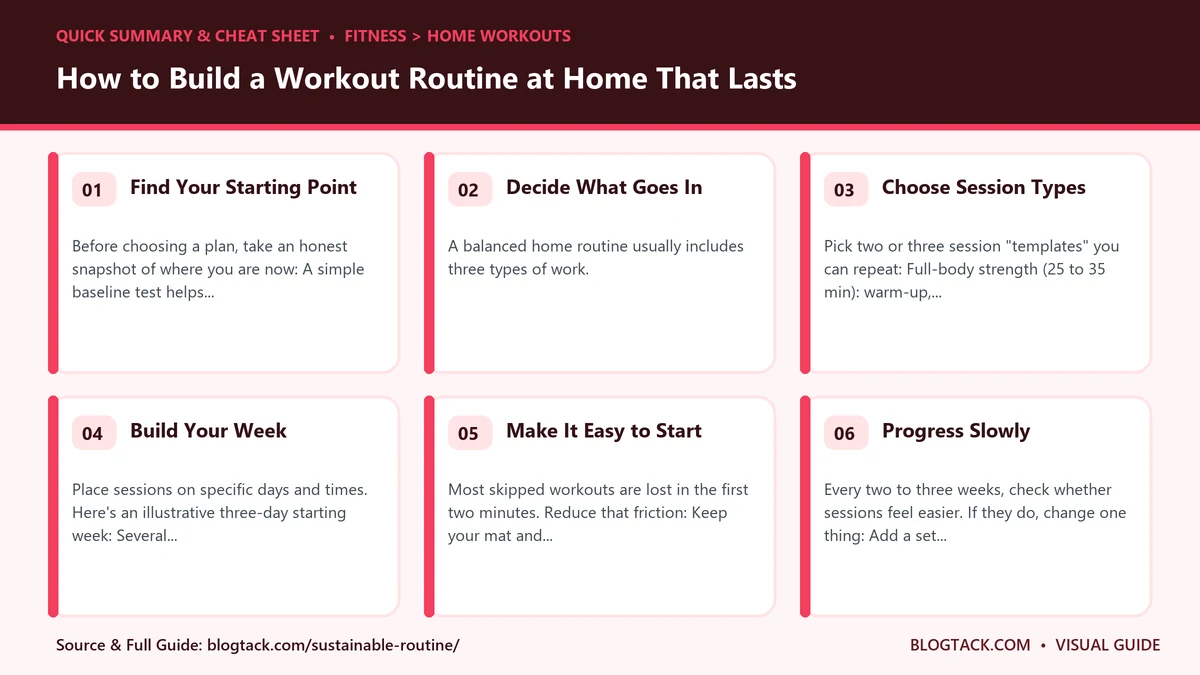
How to Build a Workout Routine at Home: Quick Recap
| Step | Action |
|---|---|
| 1 | Record your baseline and any health limits |
| 2 | Include strength, cardio and mobility across the week |
| 3 | Create two or three repeatable session templates |
| 4 | Put sessions on specific days and times |
| 5 | Remove friction: gear visible, plan written, minimum version ready |
| 6 | Progress one variable every few weeks |
| 7 | Keep one or two full rest days |
| 8 | Track sessions and how you feel |
A Note on Intensity
Most of your sessions should feel moderate: you can talk but not sing. The CDC describes moderate effort as about 5 or 6 on a 0 to 10 scale (CDC). Save harder efforts for one or two sessions a week once the routine is established. A routine that leaves you exhausted every time is hard to keep.
Involve Other People
Training with a partner, family member or online group can make routines stick. Agree on days, share a simple checklist or send each other a message after each session. Accountability works best when it’s supportive, not competitive.
Frequently Asked Questions
How many days a week should a beginner train?
Three days is a common starting point. Two good sessions beat five rushed ones.
Should I follow an online program or make my own?
Either can work. A program saves planning; your own routine can fit your space, time and preferences better. Use these steps to adjust any program.
How long until a routine feels automatic?
It varies a lot by person. Many people find it gets noticeably easier after several weeks of regular practice.
What if I get bored?
Change exercises every four to six weeks while keeping the same structure, or add a new session type you enjoy.
Should I work out in the morning or evening?
Whichever time you can protect most often. Consistency matters more than the clock.
How do I know when to change my routine?
When sessions have felt easy for a few weeks, when you’re bored, or when your schedule changes. Adjust one part at a time.
Is it OK to have a different routine every week?
Some variety is fine, but keeping the same core structure for at least four weeks makes it easier to see progress and build the habit. Pairing workouts with a realistic morning routine for mental wellness can also make showing up feel automatic.
What’s the single most important part of a routine?
Showing up regularly. A simple plan you follow beats a detailed plan you skip.
Can I build a routine around walking alone?
Walking is a great base for cardio. Add two short strength sessions a week to cover the muscle-strengthening part of the guidelines.
The Bottom Line
To build a workout routine at home that lasts, start from your real baseline, include strength, cardio and mobility across the week, use simple repeatable session templates, schedule them, progress slowly and plan for interruptions. A routine you can keep for months beats a perfect plan you drop in a fortnight.
This article is for general informational and educational purposes only and is not medical or professional fitness advice. Exercise carries inherent risks. Consult a doctor or qualified health professional before starting any new exercise program, especially if you have any health conditions, injuries, or concerns.