Stress is part of being human. A deadline, an argument, a sick child, a big move: all of these ask more of us than usual, and our bodies respond. Stress isn’t always bad. In short bursts it can help us focus and act. The trouble comes when it builds up and doesn’t ease.
This guide is about understanding stress: what happens in your body, how it differs from anxiety, how it can show up in daily life and what helps. It’s general information, not a diagnosis. If stress is affecting your health or daily life, a doctor or mental health professional can help.
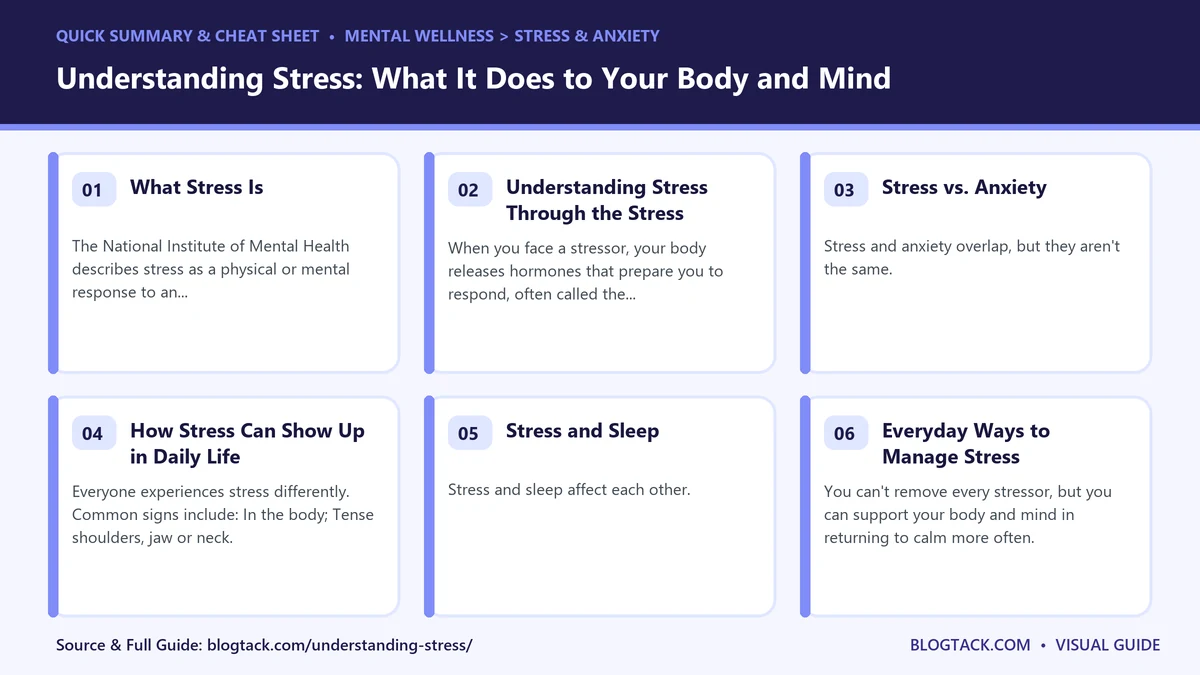
What Stress Is
The National Institute of Mental Health describes stress as a physical or mental response to an external cause, such as a big test or an argument with a friend (NIMH). The cause is called a stressor. Stressors can be one-off events or ongoing situations.
| Type | Examples | What it feels like |
|---|---|---|
| Short-term (acute) | A job interview, a near-miss in traffic, a tight deadline | Intense but passes once the event is over |
| Ongoing (chronic) | Long-term caregiving, money worries, a demanding job | Lower level but persistent, can wear you down |
| Positive stress | A wedding, a new job, a move you chose | Exciting and draining at the same time |
Understanding Stress Through the Stress Response
When you face a stressor, your body releases hormones that prepare you to respond, often called the “fight-or-flight” response. The National Center for Complementary and Integrative Health explains that your heart rate, breathing rate and blood pressure go up, your muscles tense and you sweat more (NCCIH).
That response is useful in short bursts. Once the stressor passes, gentle physical movement like stretching routines or low-impact workouts can help the body return to a calmer state, sometimes called the relaxation response. NCCIH describes it as slower breathing, lower blood pressure and a reduced heart rate (NCCIH).
Problems tend to arise when the stress response is switched on often and doesn’t have a chance to settle.
Stress vs. Anxiety
Stress and anxiety overlap, but they aren’t the same.
| Stress | Anxiety | |
|---|---|---|
| Trigger | Usually a response to an external cause | Can continue even without a current threat |
| Duration | Tends to ease once the situation is resolved | Can persist and feel constant |
| Focus | The situation in front of you | Often worry about what might happen |
NIMH notes that both can affect your mind and body, with symptoms such as excessive worry, uneasiness, tension, headaches or body pain, high blood pressure and loss of sleep (NIMH). Anxiety that persists, interferes with daily life or causes you to avoid things may be a sign of an anxiety disorder, which a professional can assess. For everyday worry, see how to manage everyday anxiety.
How Stress Can Show Up in Daily Life
Everyone experiences stress differently. Common signs include:
In the body
– Tense shoulders, jaw or neck
– Headaches
– Stomach discomfort
– Feeling tired but wired
– Changes in sleep
In the mind
– Racing or looping thoughts
– Trouble concentrating
– Forgetfulness
– Feeling overwhelmed
In emotions and behavior
– Irritability or snapping at people
– Feeling tearful or on edge
– Withdrawing from others
– Changes in appetite
– Relying more on caffeine, alcohol or screens
These are common experiences, not a checklist for diagnosis. If they’re frequent or getting worse, it’s worth talking to a doctor.
Stress and Sleep
Stress and sleep affect each other. A busy mind can make it hard to fall or stay asleep, and short sleep can make stress feel harder to handle the next day. See sleep and mental wellness for ways to support rest.
Everyday Ways to Manage Stress
You can’t remove every stressor, but you can support your body and mind in returning to calm more often.
Notice Your Stressors
NIMH suggests learning what causes or triggers your stress and which coping techniques work for you (NIMH). A simple note on your phone, “felt tense after the 3 p.m. meeting,” can reveal patterns over a week or two. Our guide to understanding emotional triggers goes deeper.
Use Your Breath
Slow, deep breathing is one of the simplest ways to encourage the relaxation response. NCCIH notes that diaphragmatic breathing exercises may help reduce stress, though the evidence is still preliminary (NCCIH). See breathing techniques for stress.
Move Your Body
Regular physical activity, even a short walk, can help release tension and improve mood and sleep.
Protect Rest
Short breaks during the day, time off from screens and enough sleep give your body a chance to recover.
Stay Connected
NIMH suggests reaching out to friends or family members who help you cope in a positive way. Talking things through, or simply spending time with someone you trust, can ease the load.
Look at What You Can Change
| Within your control | Partly within your control | Outside your control |
|---|---|---|
| How you plan your day | Workload (through conversations with your manager) | Other people’s choices |
| Saying no to some extra commitments | Family responsibilities (shared tasks) | The economy, the news |
| Sleep and movement habits | Commute or schedule | Past events |
Putting energy into the first two columns, and practicing acceptance for the third, can make stress feel more manageable.
When Stress Becomes Ongoing
Long-term stress that isn’t managed can affect health and wellbeing. In the workplace, chronic stress that hasn’t been successfully managed can lead to burnout, which the World Health Organization describes as an occupational phenomenon (WHO). See how to recognize burnout.
Building resilience can also help you cope with ongoing pressure. See how to build resilience.
When to Seek Help
Reach out to a doctor or mental health professional if:
- Stress is affecting your sleep, appetite or health for weeks
- You feel unable to cope with daily life
- You’re relying on alcohol, drugs or other behaviors to get through
- You feel hopeless, persistently low or very anxious
If you are in crisis or thinking about harming yourself, contact a local crisis line or emergency services. In the U.S., you can call or text 988 (988 Lifeline).
A Five-Minute Stress Check-In
Once a day, or whenever you notice tension, pause and ask:
- Body: Where do I feel tension right now? Shoulders, jaw, stomach?
- Mind: What am I thinking about most?
- Feelings: What word best describes how I feel?
- Need: What would help a little right now: a break, water, movement, a conversation?
- Action: What’s one small thing I can do in the next ten minutes?
This short check-in builds awareness, which makes it easier to respond before stress builds up.
Stress and Your Relationships
Stress doesn’t only affect you. It can make you shorter with people you care about, less patient or more withdrawn. If you notice this, a simple “I’m stressed today, it’s not about you” can help. It’s also a reminder that the people around you may be carrying stress too. Shared walks, meals or a short chat can ease things for everyone.
Common Myths About Stress
| Myth | A more helpful view |
|---|---|
| “Stress is always harmful.” | Short-term stress can help you focus and act. |
| “If I’m stressed, I’m not coping.” | Stress is a normal response; coping is about recovery afterward. |
| “Strong people don’t feel stress.” | Everyone feels stress. Asking for help is a strength. |
| “I just need to push through.” | Rest and breaks often help you handle stress better. |
| “Relaxing means doing nothing.” | Gentle activity, connection and hobbies can all be restful. |
Stress Across Life Stages
Stressors change over time. Students may face exams and uncertainty about the future; working adults may juggle careers, money and family; older adults may deal with health changes or loss. Recognizing that stress looks different at each stage can make it easier to be patient with yourself and others.
Frequently Asked Questions
Is all stress bad?
No. Short-term stress can help you focus and respond to challenges. It’s ongoing, unmanaged stress that tends to cause problems.
Can stress cause physical symptoms?
Yes. Stress can show up as tension, headaches, stomach upset and sleep problems. If you have physical symptoms, check with a doctor to rule out other causes.
How do I know if it’s stress or anxiety?
Stress is usually tied to a specific situation and eases when it passes. Anxiety can continue even when there’s no clear threat. A professional can help if you’re unsure.
What’s the quickest way to calm down?
Many people find slow breathing, stepping outside or a short walk helps in the moment.
Can stress affect my immune system?
Long-term stress may affect many body systems. If you’re often unwell or run down, speak to a doctor.
The Bottom Line
Understanding stress starts with knowing it’s a normal response that becomes a problem when it builds up without relief. Notice your stressors, give your body chances to return to calm through breathing, movement, rest and connection, and focus on what you can change. If stress feels overwhelming or won’t ease, professional support can make a real difference.
This article is for general informational and educational purposes only and is not medical advice, therapy, or a substitute for professional mental health care. If you are struggling with your mental health, please reach out to a qualified mental health professional. If you are in crisis, contact a local crisis line or emergency services.