Cardio doesn’t require a treadmill, a bike or a running route. You can get your heart and lungs working in a living room, a hallway or a spare bedroom, at whatever level suits you today.
This guide to cardio at home covers how much to aim for, how to judge intensity, options from very easy to more demanding, sample sessions and how to stay safe. If you have a heart condition, breathing problems or other health concerns, speak to a doctor before starting.
What Counts as Cardio
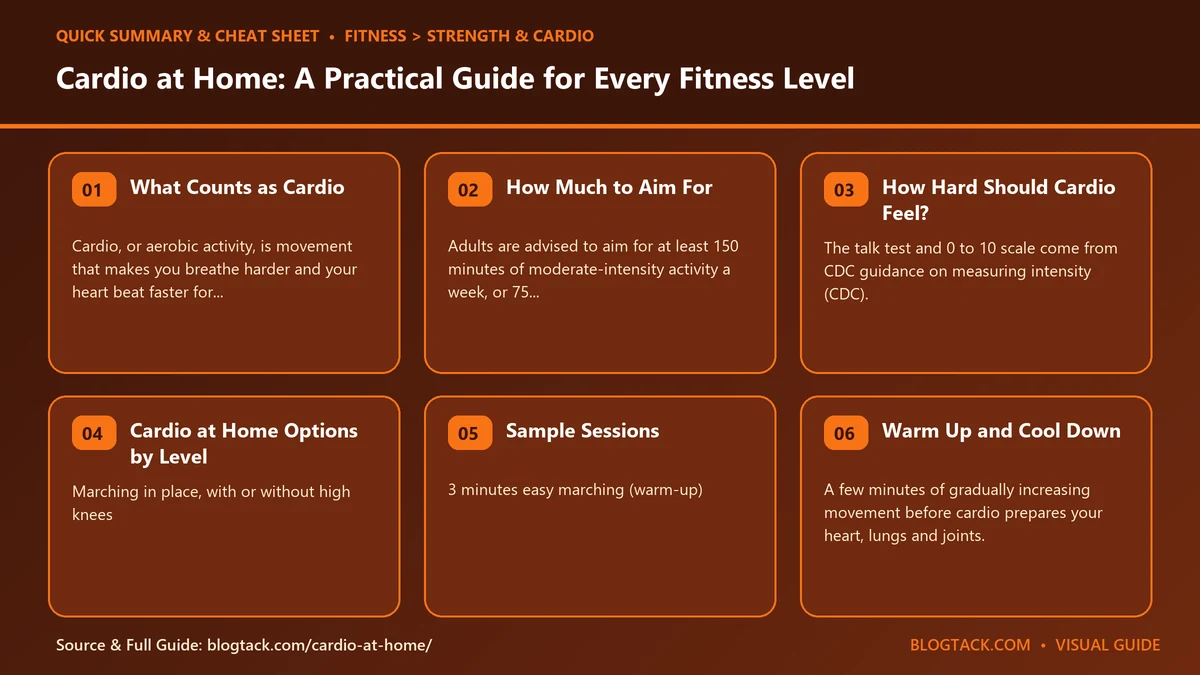
Cardio, or aerobic activity, is movement that makes you breathe harder and your heart beat faster for a sustained period. The CDC counts aerobic activity toward weekly goals when it’s done at moderate or vigorous intensity (CDC).
How Much to Aim For
Adults are advised to aim for at least 150 minutes of moderate-intensity activity a week, or 75 minutes of vigorous activity, or a mix (CDC). It can be broken into shorter chunks. Three 10-minute sessions in a day count the same as one 30-minute session.
If you’re starting from very little, begin with a few short sessions a week and build up over months.
How Hard Should Cardio Feel?
| Level | Talk test | Effort (0 to 10) | Example at home |
|---|---|---|---|
| Light | Can sing | 3 to 4 | Easy marching in place |
| Moderate | Can talk, can’t sing | 5 to 6 | Brisk marching with arm swings, step-ups |
| Vigorous | Only a few words at a time | 7 to 8 | Jumping jacks, fast step routines, intervals |
The talk test and 0 to 10 scale come from CDC guidance on measuring intensity (CDC). Most beginner sessions should sit in the moderate range.
Cardio at Home Options by Level
Low-Impact (Easy on Joints)
- Marching in place, with or without high knees
- Step touches side to side
- Low-impact “jacks” (step one foot out at a time with arm raises)
- Step-ups on a sturdy, low step
- Shadow boxing
- Walking laps of your home or garden
- Dancing to music
See our full guide to low-impact workouts for beginners.
Moderate to Higher Impact
- Jumping jacks
- Skaters (side-to-side hops)
- Jump rope, if ceiling height and floor allow
- Mountain climbers
- Squat jumps (only once squats are solid)
Higher-impact moves raise intensity quickly but put more stress on joints. Build up gradually, use a cushioned surface and supportive shoes, and skip them if they cause pain.
Sample Sessions
Beginner: 15-Minute Steady Session
- 3 minutes easy marching (warm-up)
- 9 minutes alternating 1 minute each: brisk march with arm swings, step touches, low-impact jacks
- 3 minutes easy marching and light stretches (cool-down)
Intermediate: 20-Minute Interval Session
- 4-minute warm-up (marching, arm circles, easy leg swings)
- 6 rounds: 40 seconds of a harder move (jumping jacks, skaters, fast step-ups), then 80 seconds of easy marching
- 4-minute cool-down
That’s 4 + (6 × 2) + 4 = 20 minutes.
Low-Impact Interval Option
Same structure as above, but replace harder moves with fast step-ups, punches with a quick march, or low-impact jacks at a faster pace.
Warm Up and Cool Down
A few minutes of gradually increasing movement before cardio prepares your heart, lungs and joints. Finishing with easy movement lets your heart rate come down gradually. The National Institute on Aging suggests light activity such as easy walking before and after endurance activities (NIA). For a full routine, see how to warm up before a workout.
Small Spaces and Noise
- Choose moves that stay in one spot: marching, step touches, shadow boxing.
- Swap jumps for fast low-impact versions if you have neighbors below.
- A thick mat reduces noise and impact.
- Clear the area of trip hazards first.
More ideas in home workouts for small spaces.
Balancing Cardio With Strength
Cardio and strength complement each other. You can alternate days, or do strength first and a short cardio block after. Avoid stacking long, hard cardio before strength work when form matters most. See how to combine strength and cardio.
Recovery for Cardio
- Mix harder and easier days. Not every session needs to be intense.
- Keep at least one full rest day each week.
- Drink water around your sessions, especially in warm rooms.
- If you feel unusually tired for days, take extra rest. See rest and recovery.
Safety Signals
Stop and seek medical help if you notice chest pain or pressure, severe breathlessness, dizziness, an irregular heartbeat or fainting. Mild breathlessness that settles quickly when you slow down is expected during cardio; symptoms that don’t settle aren’t.
Building Up Over Time
| Phase | Weekly focus |
|---|---|
| Weeks 1 to 2 | 2 to 3 sessions of 10 to 15 minutes at light to moderate effort |
| Weeks 3 to 4 | 3 sessions of 15 to 20 minutes, mostly moderate |
| Weeks 5 to 8 | 3 to 4 sessions of 20 to 30 minutes; try one interval session |
| After that | Build gradually toward 150 minutes of moderate activity a week |
This is an illustrative path. Adjust it to how you feel.
Keeping It Interesting
- Make playlists that match your session length.
- Rotate three or four session types through the week.
- Use follow-along videos for variety.
- Count “minutes moved” each week rather than chasing intensity.
Choosing the Right Session for the Day
| How you feel | Session choice |
|---|---|
| Fresh and energetic | Interval session or longer steady session |
| A bit tired | Short steady session at light to moderate effort |
| Sore legs from strength day | Upper-body focused cardio like shadow boxing |
| Stressed or low mood | Dance or a relaxed walk; keep it enjoyable |
| Unwell, feverish or very fatigued | Rest |
Matching the session to the day helps you stay consistent without overdoing it.
Gear That Helps (But Isn’t Required)
- Supportive athletic shoes for stepping and jumping
- A thick mat for cushioning and noise reduction
- A sturdy, non-slip step for step-ups
- A jump rope, if you have the ceiling height
- A timer app for intervals
Mixing Steady and Interval Sessions
Steady sessions keep your effort at one level for the whole workout. Interval sessions alternate harder bursts with easier recovery periods. Both have a place.
| Steady | Intervals | |
|---|---|---|
| Effort | Mostly moderate throughout | Short bursts of vigorous effort, then easy |
| Best for | Building a base, active recovery days, beginners | Variety, time-efficient sessions once a base is built |
| How often | Most cardio sessions | One or two a week at most for beginners |
| Watch out for | Boredom | Overdoing intensity, joint stress from jumping |
A good beginner mix is mostly steady sessions with one interval session a week after the first month.
Cardio Without “Exercise”
Daily activity adds up too. Taking stairs, walking during phone calls, carrying shopping and active play with kids all count when they raise your breathing. The CDC notes that any aerobic activity counts as long as it’s done at moderate or vigorous intensity (CDC). On busy days, these moments keep you moving even if a planned session doesn’t happen.
Frequently Asked Questions
Is walking around the house real cardio?
If it raises your breathing to a moderate level, yes. Brisk pace and arm swings help.
Do I need a heart rate monitor?
No. The talk test and 0 to 10 effort scale work well for most people.
How often can I do cardio?
Moderate cardio can be done most days. Mix in easier days and keep at least one rest day.
Is high-intensity interval training safe for beginners?
Start with moderate steady sessions first. Introduce intervals gradually, and talk to a doctor if you have health concerns.
What if jumping hurts my knees?
Use low-impact options instead. They still count toward your weekly activity.
Can cardio be split into short bursts?
Yes. The CDC notes that weekly activity can be broken into smaller chunks spread across the week. Two or three 10-minute sessions in a day all count.
Is it OK to do cardio on strength days?
Yes. Do strength first if form matters, or keep the cardio light. See our guide on combining both.
Does cleaning or gardening count as cardio?
It can, if it’s brisk enough to raise your breathing to a moderate level for a sustained stretch. Vigorous digging or fast-paced housework often qualifies.
The Bottom Line
Cardio at home can be as easy or as demanding as you need. Aim to build toward 150 minutes of moderate activity a week, use the talk test to judge effort, start with low-impact options and progress gradually. Warm up, cool down, mix in easier days and stop if anything feels wrong.
This article is for general informational and educational purposes only and is not medical or professional fitness advice. Exercise carries inherent risks. Consult a doctor or qualified health professional before starting any new exercise program, especially if you have any health conditions, injuries, or concerns.