
Saying yes to everything can feel kind in the moment. Over time, it often leads to exhaustion, resentment and the sense that your own needs come last. Boundaries help you protect your time, energy and wellbeing while still caring about other people.
This guide explains how to set healthy boundaries: what they are, how to recognize when you need them, how to communicate them and what to do when people push back.
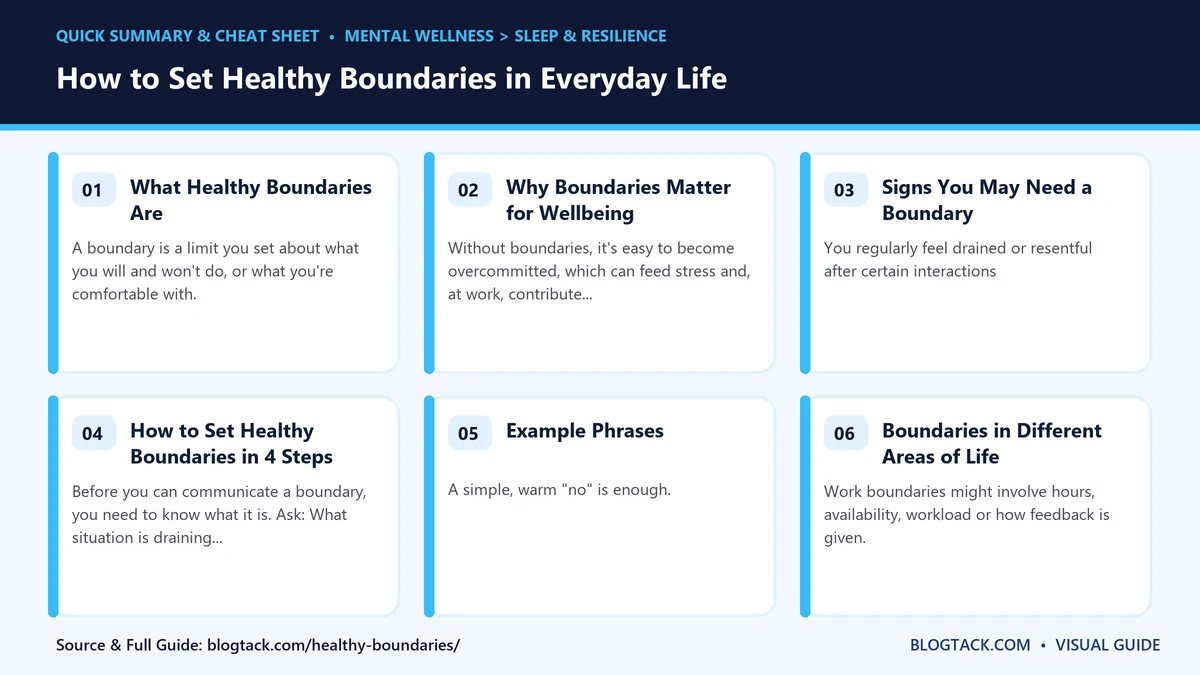
What Healthy Boundaries Are
A boundary is a limit you set about what you will and won’t do, or what you’re comfortable with. It’s about your own actions, not about controlling others.
| A boundary is | A boundary isn’t |
|---|---|
| “I don’t take work calls after 7 p.m.” | “You’re not allowed to call me.” |
| “I can help on Saturday morning, not all weekend.” | A punishment |
| “I’m not comfortable discussing my weight.” | A demand that someone change |
| A clear statement of your limits | Something you need to justify at length |
Boundaries can be firm or flexible, and they can change as your life changes.
Why Boundaries Matter for Wellbeing
Without boundaries, it’s easy to become overcommitted, which can feed stress and, at work, contribute to burnout. See how to recognize burnout. Clear limits help you:
- Keep energy for the things and people that matter most
- Reduce resentment in relationships
- Make space for rest and self-care
- Be more honest with others
Signs You May Need a Boundary
- You regularly feel drained or resentful after certain interactions
- You say yes and immediately wish you’d said no
- You feel responsible for other people’s feelings or problems
- You have little time for rest or things you enjoy
- You feel anxious about letting people down
These signs are common. They’re simply information about where a limit might help.
How to Set Healthy Boundaries in 4 Steps
Step 1: Notice What You Need
Before you can communicate a boundary, you need to know what it is. Ask:
- What situation is draining me?
- What would make it feel manageable?
- What am I willing to do, and what am I not?
Writing it down helps. “I want to stop answering messages during dinner” is clearer than “I need more time for myself.”
Step 2: Keep It Simple and Clear
Boundaries work best when they’re short and specific. You don’t need to over-explain.
Step 3: Communicate Calmly
Choose a calm moment when possible. Use “I” statements that focus on your needs.
Step 4: Follow Through
A boundary only works if you act on it. If you’ve said you won’t answer calls after 7 p.m., don’t answer them. Consistency helps people understand and adjust.
Example Phrases
| Situation | Phrase |
|---|---|
| Extra work request | “I can’t take that on this week, but I could look at it next Monday.” |
| Late-night work messages | “I check messages until 6 p.m. I’ll reply first thing tomorrow.” |
| Family visit | “We’d love to see you. We can host on Saturday afternoon.” |
| Unwanted advice | “I appreciate that you care. I’d like to figure this one out myself.” |
| Lending money | “I’m not able to lend money right now.” |
| A friend venting daily | “I care about you. I don’t have the energy to talk tonight; can we catch up tomorrow?” |
| Personal comments | “I’d rather not talk about that.” |
A simple, warm “no” is enough. You don’t owe a long explanation.
Boundaries in Different Areas of Life
At Work
Work boundaries might involve hours, availability, workload or how feedback is given. For more, see how to create work-life balance.
With Family
Family boundaries can feel hardest because of history and expectations. Start with small, low-stakes limits and build from there.
With Friends
Good friendships can handle honest limits. You can care deeply about someone and still not be available all the time. If a friend is struggling, see how to support a struggling friend, which also covers protecting your own wellbeing.
With Yourself
Boundaries also apply to your own habits: a cut-off time for screens, a limit on how much you work on weekends, or not checking email first thing in the morning.
When People Push Back
Some people will be surprised or unhappy when you start setting limits, especially if you’ve always said yes. That’s normal.
- Stay calm and repeat yourself. “I understand, and I’m still not able to.”
- Acknowledge their feelings without changing your answer. “I know this is disappointing.”
- Avoid long debates. You don’t need to win an argument.
- Notice patterns. If someone repeatedly ignores your limits, you may need to adjust how much time you spend with them.
If you feel unsafe in any relationship, reach out to a trusted person, a professional or a local support service.
Handling Guilt
Guilt is a common feeling when setting boundaries, especially at first. It doesn’t mean you’re doing something wrong; it often means you’re doing something new. Remind yourself why the boundary matters. If guilt turns into harsh self-criticism, see how to deal with negative self-talk.
Boundaries and Emotions
Strong reactions to certain requests or behaviors can point to where boundaries are needed. Our guide to understanding emotional triggers can help you notice these patterns.
It Takes Practice
Setting boundaries is a skill. It may feel awkward at first, and you may not always get it right. Start small, practice in lower-stakes situations and build confidence over time.
When You Need More Support
If boundary-setting feels impossible, or relationships are causing ongoing distress, a counselor or therapist can help you explore patterns and practice new ways of responding. The American Psychological Association notes that getting help when you need it is an important part of building resilience (APA). NIMH also has information on finding mental health support (NIMH).
Practicing a Boundary Before You Say It
If boundaries make you nervous, a little preparation helps:
- Write the sentence down. Keep it to one or two lines.
- Say it out loud to yourself or a trusted friend.
- Plan your response to pushback. One calm sentence you can repeat, such as “I understand, and my answer is still no.”
- Choose your timing. A calm moment works better than the middle of a heated conversation.
- Reflect afterward. What went well? What would you change next time?
Small Boundaries to Start With
Starting small builds confidence. Some low-stakes options:
- Turning off notifications for one app in the evening
- Letting a call go to voicemail when you’re eating
- Saying “Let me check and get back to you” before agreeing to plans
- Leaving a social event at the time you planned
- Declining one optional meeting a week
Each small boundary you keep makes the next one feel easier.
Digital Boundaries
Phones and messages can make it feel like you must always be available. Clear digital limits help. Some people set “do not disturb” hours, use auto-replies after work, or tell friends they reply to non-urgent messages once a day. See how to create work-life balance for work-specific ideas.
Boundaries and Kindness
A common worry is that boundaries will make you seem unkind. In practice, clear limits often make relationships kinder. When people know where they stand, there’s less guessing and less resentment. You can deliver a boundary warmly: thank the person, acknowledge their need and then state your limit. Kindness and boundaries work well together.
Frequently Asked Questions
Are boundaries selfish?
No. They protect your wellbeing and often make relationships healthier and more honest.
What if someone gets angry?
Their feelings are valid, but they don’t have to change your limit. Stay calm and consistent.
Do I need to explain my boundaries?
A brief reason can help, but you don’t owe a long justification.
Can boundaries change?
Yes. They can shift as your needs, energy and relationships change.
What if I’ve never set boundaries before?
Start with one small, low-stakes limit. Each one you keep builds confidence for the next.
How do I set boundaries with my boss?
Focus on workload and priorities. “I can finish A by Friday. If B is more urgent, which should I move?” keeps the conversation practical.
Is it OK to end a relationship that keeps crossing my boundaries?
Sometimes stepping back is the healthiest choice. A counselor can help you think it through.
Can I set a boundary by text or email?
Yes, especially if it helps you stay calm. Keep it short, clear and kind.
What if I feel I have to explain myself?
Try a short reason, then stop. “I need an early night” is enough.
The Bottom Line
Learning how to set healthy boundaries means noticing what you need, stating it simply and calmly, and following through. Expect some discomfort and pushback at first, and treat yourself kindly as you practice. Boundaries aren’t walls; they’re a way of caring for yourself so you can keep caring for others.
This article is for general informational and educational purposes only and is not medical advice, therapy, or a substitute for professional mental health care. If you are struggling with your mental health, please reach out to a qualified mental health professional. If you are in crisis, contact a local crisis line or emergency services.

