People sometimes assume bodyweight training stops working once you can do a few push-ups. It doesn’t, as long as the exercise keeps getting harder. The secret isn’t more exercises. It’s climbing a ladder of variations for a handful of basic movements.
This guide explains how bodyweight exercises for strength work, the progression ladders for each main movement, and how to know when to move up. For step-by-step instructions on individual moves, see our list of 10 full-body bodyweight exercises.
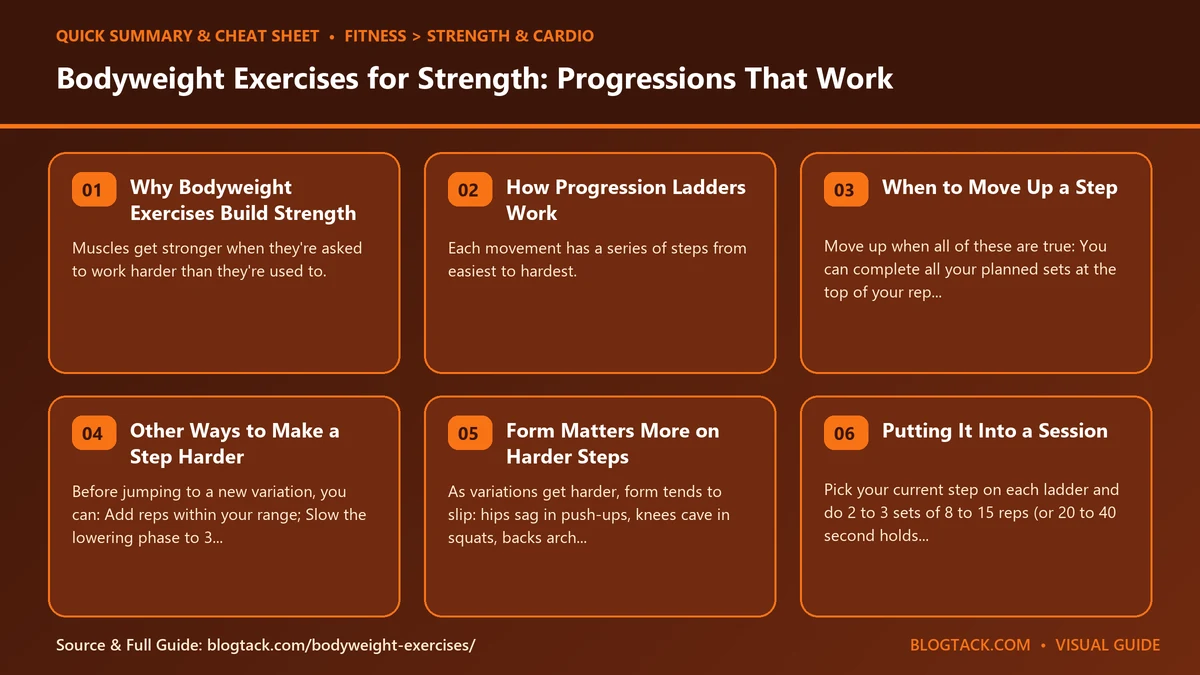
Why Bodyweight Exercises Build Strength
Muscles get stronger when they’re asked to work harder than they’re used to. Bodyweight exercise does that through leverage, range of motion, speed and the number of limbs supporting you. A push-up against a wall and a push-up on the floor use the same pattern, but the floor version asks your muscles to move far more of your weight.
The CDC counts muscle-strengthening activity on 2 or more days a week, working legs, hips, back, abdomen, chest, shoulders and arms, as part of adult guidelines (CDC). Bodyweight training can cover every one of those areas.
How Progression Ladders Work
Each movement has a series of steps from easiest to hardest. You work at one step until it feels controlled for all your sets, then try the next. The ladders below are examples; exact steps vary.
Push Ladder (Chest, Shoulders, Arms)
| Step | Variation |
|---|---|
| 1 | Wall push-up |
| 2 | Counter-height incline push-up |
| 3 | Low incline (sturdy table or step) |
| 4 | Knee push-up |
| 5 | Full floor push-up |
| 6 | Slow-tempo or paused push-up |
| 7 | Feet-elevated push-up |
Squat Ladder (Thighs, Hips, Glutes)
| Step | Variation |
|---|---|
| 1 | Chair sit-to-stand |
| 2 | Box squat to a chair, without sitting fully |
| 3 | Bodyweight squat |
| 4 | Paused or slow-tempo squat |
| 5 | Split squat |
| 6 | Rear-foot elevated split squat |
Hinge Ladder (Glutes, Hamstrings, Back)
| Step | Variation |
|---|---|
| 1 | Glute bridge |
| 2 | Glute bridge with a 2-second hold |
| 3 | Single-leg glute bridge |
| 4 | Shoulders-elevated hip thrust (back on a sturdy couch) |
| 5 | Single-leg hip thrust |
Lunge Ladder (Legs, Balance)
| Step | Variation |
|---|---|
| 1 | Supported split squat, holding a wall |
| 2 | Unsupported split squat |
| 3 | Reverse lunge |
| 4 | Walking or forward lunge |
| 5 | Slow-tempo lunges |
Pull Ladder (Upper Back, Arms)
Pulling is the hardest pattern to train with no equipment. Options:
| Step | Variation |
|---|---|
| 1 | Prone “Y” and “T” raises lying face down |
| 2 | Resistance band row |
| 3 | Table row under a very sturdy table (check stability first) |
| 4 | Band row with a pause at the top |
A resistance band is the safest low-cost way to train pulling at home.
Core Ladder
| Step | Variation |
|---|---|
| 1 | Dead bug |
| 2 | Forearm plank on knees |
| 3 | Forearm plank |
| 4 | Side plank on knees, then full |
| 5 | Plank with shoulder taps |
When to Move Up a Step
Move up when all of these are true:
- You can complete all your planned sets at the top of your rep range (for example, 3 sets of 12).
- Your form stays the same on the last rep as on the first.
- The effort feels about 6 or 7 out of 10, not maximal.
If the new step lets you do only 3 or 4 reps, mix it in: do one set of the harder version and the rest at the old step until you build up.
Other Ways to Make a Step Harder
Before jumping to a new variation, you can:
- Add reps within your range.
- Slow the lowering phase to 3 seconds.
- Pause at the hardest point for 1 to 2 seconds.
- Reduce rest slightly.
- Increase the range of motion, if it’s comfortable.
See how to make workouts harder for more detail.
Form Matters More on Harder Steps
As variations get harder, form tends to slip: hips sag in push-ups, knees cave in squats, backs arch in planks. Watch for these and drop back a step if needed. Our list of common workout mistakes covers the most frequent technique errors.
The National Institute on Aging advises breathing out as you lift or push and breathing in as you relax, rather than holding your breath (NIA).
Putting It Into a Session
Pick your current step on each ladder and do 2 to 3 sets of 8 to 15 reps (or 20 to 40 second holds for planks), two or three times a week on non-consecutive days. For a full plan, see strength training at home for beginners.
What to Expect
Early progress often comes quickly as you learn the movements. After a few weeks, steps take longer to climb. That’s normal. Mild soreness after a new step is common; sharp or joint pain isn’t. See muscle soreness after a workout.
Frequently Asked Questions
Can bodyweight exercises build as much strength as weights?
For beginners, bodyweight work builds plenty of strength. Over time, adding resistance like bands or weights makes progression easier for some movements, especially pulling and legs.
How many exercises do I need?
One from each ladder (push, squat, hinge, lunge, pull, core) covers the whole body.
How long should I stay on one step?
As long as it takes. Some steps take a week; others take a couple of months.
What if a step hurts?
Go back a step or choose another variation. Pain in a joint is a reason to stop, not push through.
The Bottom Line
Bodyweight exercises for strength work when they keep getting harder. Choose one movement from each pattern, find your step on the ladder, move up once all sets feel controlled and keep form strict as the challenge rises. Steady progression, not more exercises, is what builds strength.
This article is for general informational and educational purposes only and is not medical or professional fitness advice. Exercise carries inherent risks. Consult a doctor or qualified health professional before starting any new exercise program, especially if you have any health conditions, injuries, or concerns.