A workout split is just a plan for what you train on which day. Gym culture has made it sound complicated, with “push-pull-legs” and “bro splits.” For beginners training at home, it can be very simple: a few strength days, a few cardio days and enough rest in between.
This guide explains how a weekly workout split for beginners works and gives four ready-made templates. For the bigger picture of designing a routine, see how to build a workout routine at home.
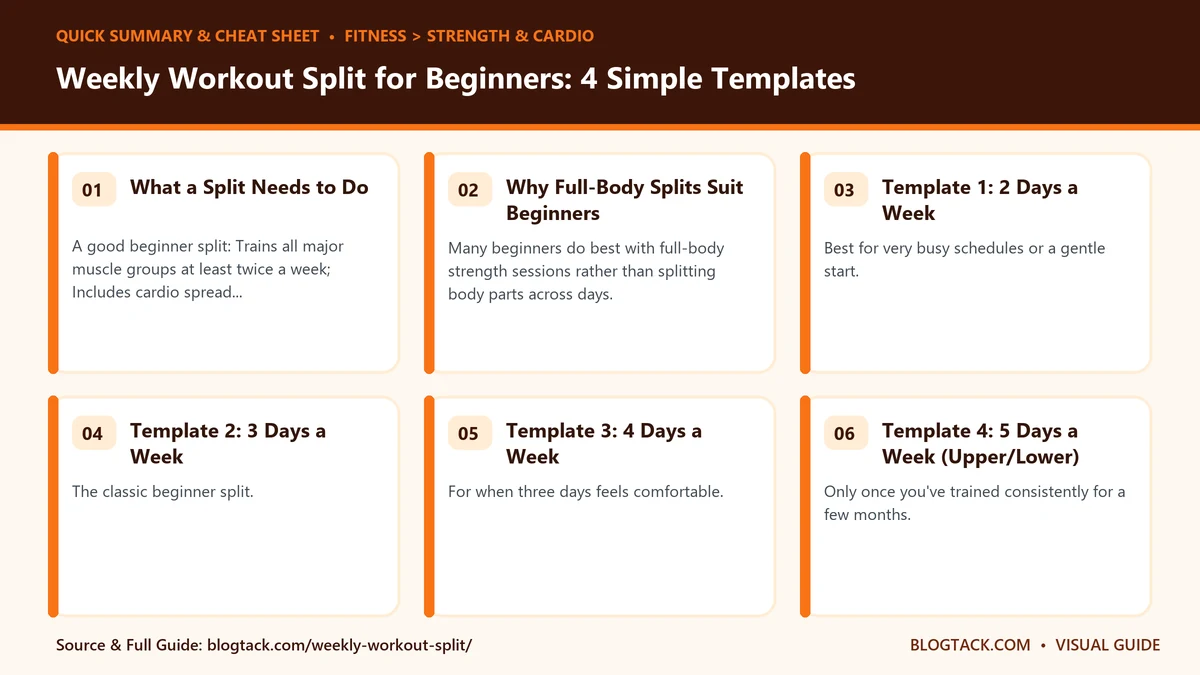
What a Split Needs to Do
A good beginner split:
- Trains all major muscle groups at least twice a week
- Includes cardio spread across the week
- Avoids hard strength work for the same muscles on back-to-back days
- Includes at least one or two full rest days
- Fits your actual schedule
These goals line up with the CDC’s adult guidelines: at least 150 minutes of moderate aerobic activity a week and muscle-strengthening on 2 or more days (CDC).
Why Full-Body Splits Suit Beginners
Many beginners do best with full-body strength sessions rather than splitting body parts across days. Full-body sessions let you practice each movement more often, which helps you learn technique, and missing one session doesn’t leave a body part untrained for a week.
Template 1: 2 Days a Week
Best for very busy schedules or a gentle start.
| Day | Session |
|---|---|
| Monday | Full-body strength + 10 min cardio |
| Tuesday | Rest or walk |
| Wednesday | Rest or walk |
| Thursday | Full-body strength + 10 min cardio |
| Friday to Sunday | Walks, active hobbies, rest |
Add short walks on other days to build cardio minutes.
Template 2: 3 Days a Week
The classic beginner split.
| Day | Session |
|---|---|
| Monday | Full-body strength |
| Tuesday | Rest or easy walk |
| Wednesday | Cardio (20 to 30 min) |
| Thursday | Rest |
| Friday | Full-body strength |
| Saturday | Cardio or active outing |
| Sunday | Rest |
Template 3: 4 Days a Week
For when three days feels comfortable.
| Day | Session |
|---|---|
| Monday | Full-body strength A |
| Tuesday | Cardio (steady) |
| Wednesday | Rest |
| Thursday | Full-body strength B |
| Friday | Cardio (steady or light intervals) |
| Saturday | Mobility or walk |
| Sunday | Rest |
“A” and “B” use different exercise variations for the same patterns, which adds variety.
Template 4: 5 Days a Week (Upper/Lower)
Only once you’ve trained consistently for a few months.
| Day | Session |
|---|---|
| Monday | Lower body strength + core |
| Tuesday | Upper body strength |
| Wednesday | Cardio |
| Thursday | Lower body strength + core |
| Friday | Upper body strength |
| Saturday | Light cardio or mobility |
| Sunday | Rest |
Upper and lower days alternate, so each area gets recovery between sessions.
How to Choose Your Weekly Workout Split for Beginners
| If you… | Start with |
|---|---|
| Are new or returning after a long break | 2 or 3 days |
| Have about 3 hours a week | 3 days |
| Have trained steadily for 2 to 3 months | 4 days |
| Enjoy training most days and recover well | 4 or 5 days |
| Have an unpredictable schedule | 2 or 3 days, with flexible placement |
When in doubt, start with fewer days. It’s easier to add a day than to recover from burnout.
Placing Rest Days
- Put rest or light days after your hardest sessions.
- Avoid two hard full-body strength days in a row.
- If a day is missed, shift the week instead of doubling up.
See rest and recovery for more.
Combining Strength and Cardio in a Day
If you prefer fewer training days, you can do strength and cardio in the same session. Generally, strength first, then a shorter cardio block. See how to combine strength and cardio.
Adjusting Week to Week
Life changes week to week, and your split can too. The CDC notes activity can be spread through the week and broken into smaller chunks (CDC). On a busy week, switch to the 2-day template. For more ideas, see home workouts for a busy schedule.
What Goes Into a Full-Body Session
Each full-body strength day in these templates follows the same basic structure:
- 5-minute warm-up
- One squat or lunge movement
- One push movement
- One hinge movement
- One pull movement (bands work well)
- One core movement
- 3 to 5-minute cool-down
Two or three sets of each is plenty for most beginners.
Frequently Asked Questions
Do beginners need a split at all?
A simple plan helps you stay consistent and recover well. “Split” just means that plan.
Is a full-body workout three times a week too much?
For many beginners, full-body sessions on non-consecutive days work well. Keep the volume moderate at first. See strength training at home.
What should I do on rest days?
Normal daily activity, an easy walk or light stretching if you like.
Can I swap days around?
Yes. Keep hard sessions apart and include rest.
When should I move from one template to the next?
When your current template has felt comfortable for several weeks, you’re recovering well between sessions and you have the time. Add one day, not two.
What if my week has no fixed pattern?
Use a rotating list instead of fixed days: strength, cardio, rest, strength, cardio, rest. Do the next item whenever you can train.
The Bottom Line
A weekly workout split for beginners should train everything at least twice a week, mix in cardio, separate hard sessions and include rest days. Start with the 2 or 3-day template, stay consistent for a couple of months, then add a day if you’re recovering well.
This article is for general informational and educational purposes only and is not medical or professional fitness advice. Exercise carries inherent risks. Consult a doctor or qualified health professional before starting any new exercise program, especially if you have any health conditions, injuries, or concerns.