Everyone feels anxious sometimes: before a presentation, while waiting for test results, when money is tight. A certain amount of worry is a normal part of life and can even help us prepare. But when worry starts to take up a lot of space, it helps to have a few practical tools.
This guide covers how to manage everyday anxiety with simple steps for the moment and habits for the longer term. It’s not a treatment for anxiety disorders. If anxiety is persistent, intense or affecting your daily life, please talk to a doctor or mental health professional.
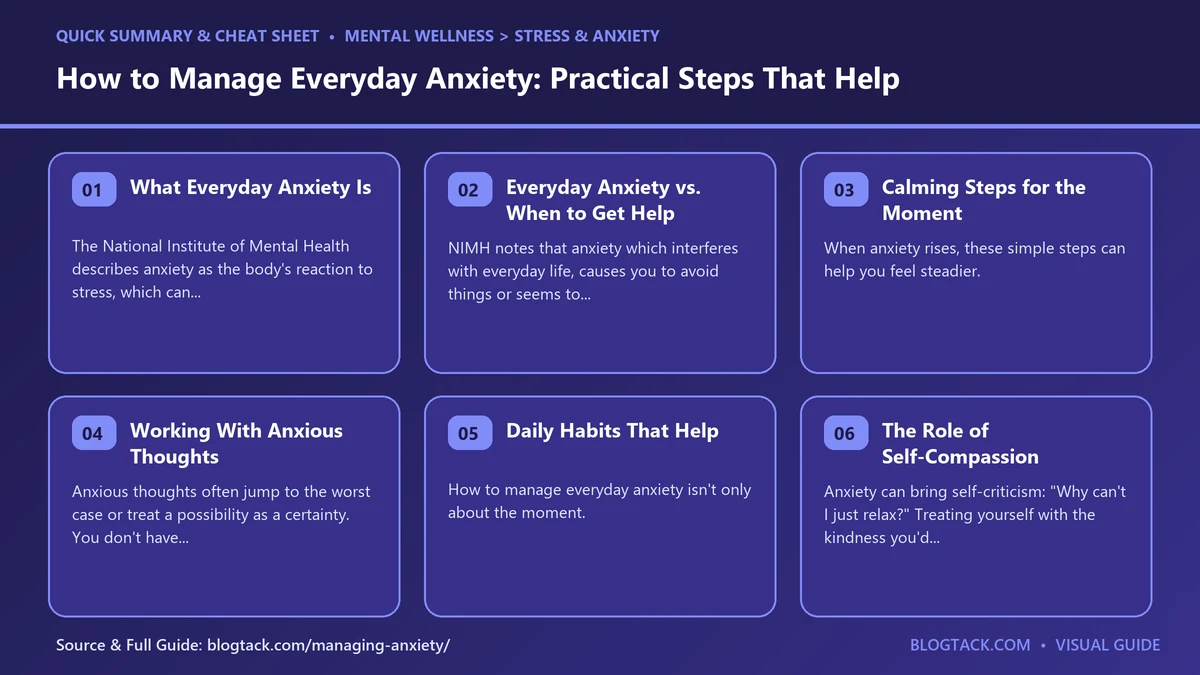
What Everyday Anxiety Is
The National Institute of Mental Health describes anxiety as the body’s reaction to stress, which can occur even when there’s no current threat (NIMH). Everyday anxiety often shows up as:
- Worry about upcoming events or “what if” scenarios
- A tight chest, racing heart or butterflies
- Restlessness or trouble sitting still
- Difficulty concentrating
- Trouble falling asleep
Everyday Anxiety vs. When to Get Help
| Everyday anxiety | Signs to talk to a professional |
|---|---|
| Linked to a specific situation | Present most days, with or without a clear cause |
| Eases after the event passes | Persists for weeks |
| Manageable alongside daily life | Interferes with work, relationships or daily tasks |
| Doesn’t cause you to avoid much | Leads you to avoid places, people or activities |
| No panic or occasional mild nerves | Frequent panic attacks or intense physical symptoms |
NIMH notes that anxiety which interferes with everyday life, causes you to avoid things or seems to always be present may be a sign of an anxiety disorder, and that psychotherapy and medication are the two main treatments (NIMH). This article is for the left column.
Calming Steps for the Moment
When anxiety rises, these simple steps can help you feel steadier.
1. Slow Your Breathing
Breathing more slowly, especially with a longer out-breath, can help your body shift toward calm. Try breathing in through your nose for a count of 4 and out through your mouth for a count of 6, for a minute or two. NCCIH notes that relaxation techniques like slow breathing aim to bring about the body’s relaxation response (NCCIH). For step-by-step exercises, see breathing exercises for stress relief.
2. Ground Yourself in Your Senses
A common grounding technique is 5-4-3-2-1: notice 5 things you can see, 4 you can hear, 3 you can feel, 2 you can smell and 1 you can taste. It brings attention back to the present.
3. Name What You’re Feeling
Saying, “I’m feeling anxious about tomorrow’s meeting,” can create a little distance from the feeling.
4. Move a Little
A short walk, stretching or shaking out your hands can help release some of the physical tension that comes with anxiety.
5. Reach Out
Texting or calling someone you trust can make worry feel less heavy.
Working With Anxious Thoughts
Anxious thoughts often jump to the worst case or treat a possibility as a certainty. You don’t have to argue with every thought, but a few questions can help:
| Anxious thought | Questions to ask |
|---|---|
| “This is going to go terribly.” | What’s the evidence? What’s the most likely outcome? |
| “I can’t handle this.” | When have I handled something hard before? |
| “Everyone will judge me.” | Would I judge someone else for this? |
| “What if something goes wrong?” | If it did, what’s one step I could take? |
NIMH suggests identifying and challenging negative and unhelpful thoughts as one way to cope with stress and anxiety. For more on this, see how to deal with negative self-talk.
Scheduled Worry Time
Some people find it helpful to set aside 10 to 15 minutes a day as “worry time.” When worries come up outside that time, jot them down and return to them later. This can stop worry from spreading across the whole day.
Daily Habits That Help
How to manage everyday anxiety isn’t only about the moment. Regular habits can lower your baseline.
| Habit | Why it can help |
|---|---|
| Regular sleep schedule | Short sleep can make anxiety feel worse. See sleep and mental wellness. |
| Physical activity | Can release tension and support mood |
| Limiting caffeine | Caffeine can mimic or heighten anxious feelings in some people |
| Short mindfulness practices | Help you notice thoughts without getting swept away. See simple mindfulness practices. |
| Less news and social media scrolling | Reduces constant input of worrying information |
| Time with supportive people | Connection can make worries feel lighter |
| Writing things down | Gets looping thoughts out of your head |
The Role of Self-Compassion
Anxiety can bring self-criticism: “Why can’t I just relax?” Treating yourself with the kindness you’d show a friend makes it easier to cope. Anxiety is a common human experience, not a personal failing.
Anxiety and Stress
Anxiety and stress overlap. Learning more about the stress response can make anxious feelings less frightening. See understanding stress. For more on how breathing affects the body, see breathing techniques for stress.
How to Manage Everyday Anxiety: A Simple Daily Plan
- Morning: two minutes of slow breathing; write down your main worry and one small step you can take.
- During the day: short walk; notice when anxiety rises and use grounding.
- Evening: limit screens an hour before bed; write a short list of what went okay today.
Adjust this to your own life. The idea is to have a few go-to tools ready.
When to Seek Professional Help
Please reach out to a doctor or mental health professional if:
- Anxiety is present most days for several weeks
- It’s affecting your work, relationships or ability to function
- You’re avoiding places or activities because of anxiety
- You experience panic attacks
- You’re using alcohol or other substances to cope
Effective treatments exist. NIMH offers information on finding help (NIMH). If you’re in crisis or thinking about harming yourself, contact a local crisis line or emergency services. In the U.S., call or text 988 (988 Lifeline).
Understanding the Anxiety Cycle
Anxiety can feed itself. A worrying thought leads to physical sensations, like a racing heart. Those sensations can feel alarming, which leads to more worried thoughts. Avoiding the situation brings short-term relief but can make the worry stronger next time.
| Stage | Example | Where you can step in |
|---|---|---|
| Trigger | An email from your manager | Notice it |
| Thought | “I must have done something wrong.” | Question it |
| Body | Tight chest, fast breathing | Slow your breath |
| Behavior | Avoid opening the email | Take one small step: open it |
| Result | Relief, then more worry later | Notice what actually happened |
Knowing the cycle won’t stop anxiety, but it can help you see where a small change might help.
Keeping a Simple Anxiety Log
Writing down when anxiety shows up can reveal patterns. Note the time, what was happening, what you thought, how strong the feeling was from 1 to 10 and what helped. After a couple of weeks, look back. You may notice certain times, places or situations that come up often, or tools that work better than others. A log can also be useful to share with a doctor or therapist.
Supporting Someone Else With Anxiety
If someone you care about often feels anxious, listening without trying to fix everything can help. Ask what would be useful, offer to do a calming activity together and gently encourage them to talk to a professional if worry is persistent. See how to support a struggling friend for more ideas.
Frequently Asked Questions
Is it normal to feel anxious?
Yes. Occasional anxiety is a normal part of life. It becomes a concern when it’s persistent or interferes with daily life.
Can breathing exercises really help?
Many people find slow breathing, steady hydration, and gentle movement like cardio at home help them feel calmer in the moment. It’s a tool, not a cure.
Should I avoid things that make me anxious?
Avoidance can make anxiety grow over time. Taking small steps toward manageable challenges often helps, but a professional can guide this if anxiety is significant.
Does caffeine affect anxiety?
For some people, yes. Notice how you feel after coffee or energy drinks.
Can journaling help with anxiety?
Many people find writing down worries helps them feel less overwhelmed. It’s one tool among many.
What if anxiety wakes me up at night?
Keep a notebook by the bed to jot down worries, try slow breathing, and if it happens often, talk to a doctor.
Does exercise help with anxiety?
Many people find regular movement helps them feel calmer. Start with something manageable, like a daily walk.
Is it OK to take a break from the news?
Yes. Checking in once a day, rather than constantly, can reduce worry for many people.
The Bottom Line
How to manage everyday anxiety comes down to having calming steps for the moment, ways to work with anxious thoughts and daily habits that lower your baseline. Be kind to yourself along the way. And if anxiety is persistent or getting in the way of life, professional support can help.
This article is for general informational and educational purposes only and is not medical advice, therapy, or a substitute for professional mental health care. If you are struggling with your mental health, please reach out to a qualified mental health professional. If you are in crisis, contact a local crisis line or emergency services.