Most of us know at least a few things that help us feel steadier: a short walk, writing down what’s on our mind, going to bed at a reasonable hour. Knowing isn’t the hard part. Doing them on an ordinary Tuesday, when you’re tired and busy, is.
That gap is where habits come in. This guide explains how to build better mental habits by understanding how habits form, starting small enough to succeed and responding kindly when you slip. It’s about everyday wellbeing, not treatment. If you’re struggling with your mental health, a qualified professional can offer support that habits alone can’t.
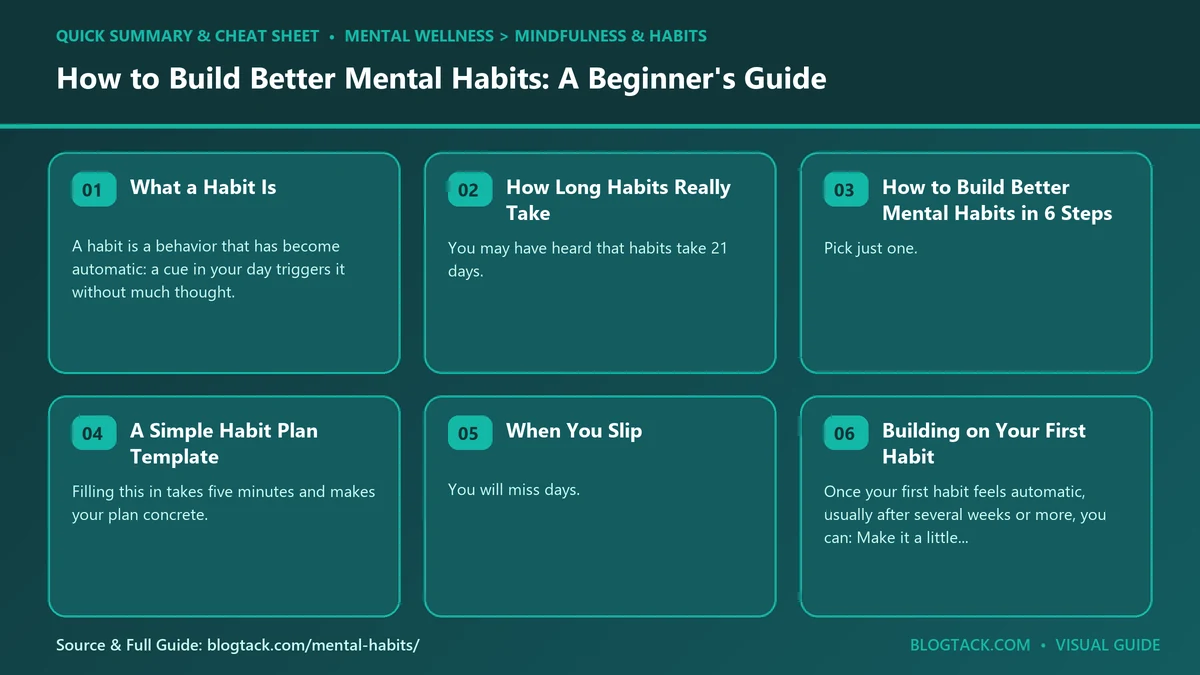
What a Habit Is
A habit is a behavior that has become automatic: a cue in your day triggers it without much thought. Brushing your teeth after breakfast is a habit. You don’t weigh up whether to do it; the cue (finishing breakfast) leads to the action.
Mental habits work the same way. Pausing to take three slow breaths when you sit at your desk, writing one line in a notebook before bed, or noticing a harsh thought and rephrasing it can all become automatic with enough repetition.
How Long Habits Really Take
You may have heard that habits take 21 days. The research suggests longer and more variable. In a well-known UCL study, Phillippa Lally and colleagues followed 96 people building a new daily behavior. On average it took 66 days to reach peak automaticity, with a wide range from 18 days to an estimated 254 days (British Psychological Society). More complex behaviors took longer.
Two findings from that work are especially encouraging:
- Missing a single day didn’t significantly affect habit formation (UCL).
- Consistency over time mattered more than perfection. People who were very inconsistent didn’t form habits, but an occasional slip was fine.
So if a new habit still takes effort after three weeks, nothing is wrong with you. It’s simply early.
How to Build Better Mental Habits in 6 Steps
Step 1: Choose One Habit
Pick just one. Adding several at once divides your attention and makes all of them harder. Ask yourself: what small change would make the biggest difference to how I feel day to day?
Some examples:
| If you’d like to… | A starter habit could be… |
|---|---|
| Feel less rushed | Three slow breaths before opening email |
| Notice your feelings more | One line in a notebook each evening |
| Sleep better | Phone on the charger outside the bedroom at a set time |
| Be kinder to yourself | Pausing once a day to ask, “What would I say to a friend?” |
| Feel more connected | Sending one message to someone you care about each day |
For more ideas, see our list of habits for mental wellness.
Step 2: Make It Tiny
Shrink the habit until it feels almost too easy. “Meditate for 20 minutes” becomes “sit and breathe for one minute.” “Journal every night” becomes “write one sentence.”
Tiny habits work because they’re hard to skip. Once the behavior is automatic, you can make it longer if you want to.
Step 3: Attach It to a Cue
Link the new habit to something you already do every day. This is often called habit stacking:
- “After I pour my morning coffee, I’ll take three slow breaths.”
- “After I brush my teeth at night, I’ll write one line in my notebook.”
- “When I sit down at my desk, I’ll check in with how I’m feeling.”
The more specific the cue, the better. “In the morning” is vague; “after I switch on the kettle” is clear.
Step 4: Make It Easy to Start
Remove anything that gets in the way. Keep the notebook and pen on your pillow. Set a gentle reminder on your phone. Put your walking shoes by the door. Small changes to your surroundings make the first step smoother.
Step 5: Notice How It Feels
After you do the habit, take a moment to notice any effect, even a small one. “That walk cleared my head a bit.” Paying attention to the benefit helps the habit feel worth repeating.
Step 6: Track Lightly
A simple tick on a calendar can be motivating. Keep it low-pressure: the goal is to see your consistency, not to judge yourself for gaps.
A Simple Habit Plan Template
| Question | Your answer |
|---|---|
| The one habit I’m building | |
| The tiny version | |
| My cue (“After I…”) | |
| What I’ll put in place to make it easy | |
| How I’ll track it | |
| What I’ll do if I miss a day |
Filling this in takes five minutes and makes your plan concrete.
When You Slip
You will miss days. Everyone does. What matters is what happens next.
- Never miss twice is a helpful rule of thumb. One missed day is a pause; two in a row starts to become a new pattern.
- Shrink it further on hard days. If one minute feels like too much, do ten seconds.
- Drop the guilt. Criticizing yourself makes it harder to start again. Treat the slip as information: was the cue unclear? Was the habit too big?
See our guide to dealing with negative self-talk if self-criticism tends to take over after a setback.
Building on Your First Habit
Once your first habit feels automatic, usually after several weeks or more, you can:
- Make it a little longer or deeper.
- Add a second habit, attached to a different cue.
- Link habits together into a short routine, like a morning routine for mental wellness.
Go slowly. A few habits that last are worth more than many that fade.
Habits That Support Each Other
Some habits make others easier. Better sleep often makes it easier to be patient with yourself. Moving your body can improve mood and sleep. Short pauses through the day, like the ones in our guide to simple mindfulness practices, can help you notice when you need a break. You don’t need all of them. Start with one and let it support the next.
Setting Realistic Expectations
Habits are not a cure for difficult feelings, and they won’t make every day good. They can make ordinary days a little steadier and give you tools you can return to when things are hard. For help setting goals you can stick to, see how to set realistic personal goals.
When Habits Aren’t Enough
Self-help habits are a good addition to everyday life, but they aren’t a replacement for professional care. The National Institute of Mental Health encourages people to seek help if they’re struggling to cope or if symptoms of stress or anxiety won’t go away (NIMH). Consider talking to a doctor or mental health professional if you notice:
- Low mood or worry most days for two weeks or more
- Difficulty managing daily tasks, work or relationships
- Changes in sleep or appetite that don’t settle
- Feeling unable to cope
If you are in crisis or thinking about harming yourself, contact a local crisis line or emergency services. In the United States, you can call or text 988 to reach the 988 Suicide & Crisis Lifeline (988 Lifeline).
Breaking an Unhelpful Habit
Building a new habit is often easier than stopping an old one. The UCL team behind the habit study noted that new habits don’t erase old ones; they have to become the stronger influence on behavior (UCL). A few ideas that can help:
- Notice the cue. What usually happens just before the habit? Boredom, a certain time of day, a notification?
- Replace, don’t just remove. If you scroll your phone in bed, put a book on your pillow instead.
- Add friction. Make the old habit slightly harder, such as logging out of an app or leaving your phone in another room.
Frequently Asked Questions
How many habits should I work on at once?
One, at least until it feels automatic. Then add another if you want to.
What’s the best habit to start with?
The one that feels most useful and easiest for you. Sleep, movement and short pauses are common starting points.
What if I keep forgetting?
Make the cue more specific or add a visible reminder, like a sticky note where you’ll see it.
Do habits really help mental wellbeing?
Many people find that small daily practices help them feel steadier. They work best alongside rest, connection and, when needed, professional support. See how to build a self-care routine.
Can I build a habit if my schedule changes every day?
Yes. Use a cue that happens daily regardless of timing, like your first coffee or getting into bed, rather than a fixed clock time.
The Bottom Line
Learning how to build better mental habits comes down to choosing one habit, making it tiny, attaching it to a clear cue, making it easy to start and responding kindly when you slip. Expect it to take weeks or months, not days. And if habits aren’t enough on their own, reaching out for professional support is a strong and sensible step.
This article is for general informational and educational purposes only and is not medical advice, therapy, or a substitute for professional mental health care. If you are struggling with your mental health, please reach out to a qualified mental health professional. If you are in crisis, contact a local crisis line or emergency services.