When your head feels crowded, putting thoughts on paper can make them easier to see. A worry that loops endlessly in your mind often looks smaller, or at least clearer, once it’s written down. Journaling doesn’t need special notebooks or perfect sentences. It just needs a few minutes and honesty.
This guide covers journaling for mental clarity: different methods to try, how to get started and how to keep the practice going. For ready-made questions, see our list of journaling prompts for self-reflection.
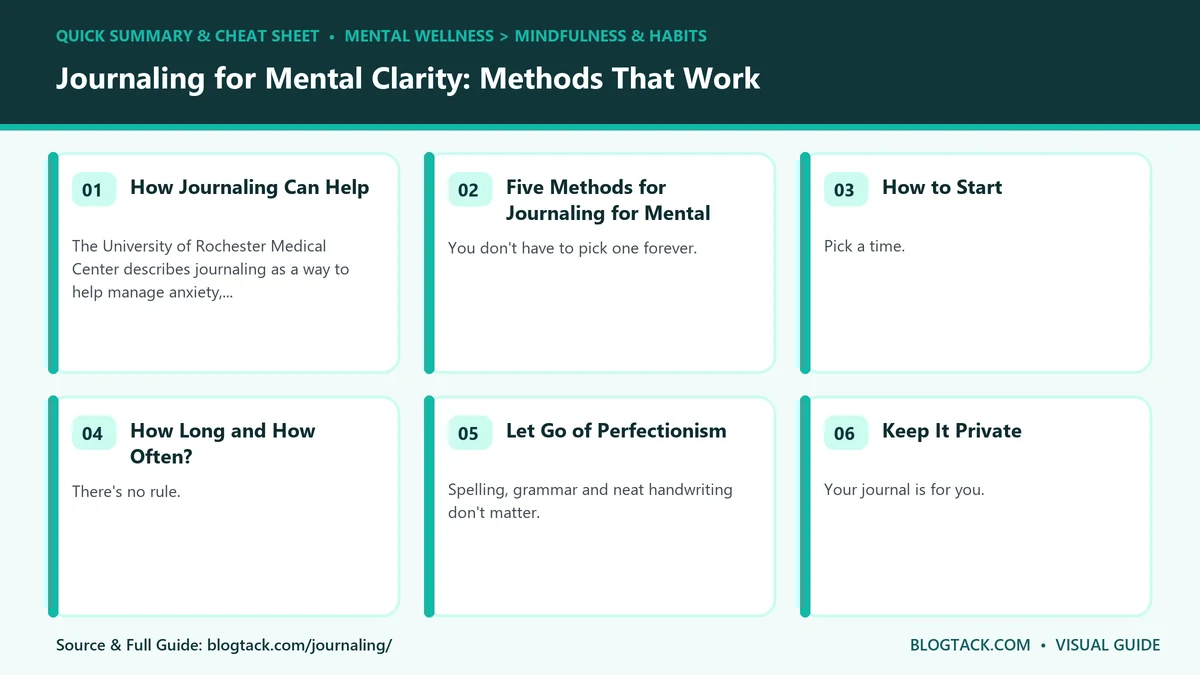
How Journaling Can Help
The University of Rochester Medical Center describes journaling as a way to help manage anxiety, reduce stress and cope with depression, by helping you prioritize problems, track symptoms day to day and recognize triggers (URMC). Many people also find it helps them:
- Untangle racing thoughts
- Notice patterns in mood, sleep or stress
- Make decisions by seeing options laid out
- Process events before reacting
- Remember what’s going well
It’s a support for everyday wellbeing, not a replacement for professional help.
Five Methods for Journaling for Mental Clarity
| Method | How it works | Best for |
|---|---|---|
| Free writing | Write whatever comes to mind for a set time without stopping | Clearing a busy head |
| Brain dump list | List every task, worry and idea, then sort them | Feeling overwhelmed by “too much” |
| Prompted writing | Answer one question, like “What do I need today?” | When you don’t know where to start |
| Gratitude notes | Write a few things that went well or that you appreciate | Shifting attention toward the positive |
| Mood and event log | Note the day’s mood, sleep and key events | Spotting patterns over weeks |
You don’t have to pick one forever. Many people switch depending on the day.
Free Writing
Set a timer for 5 to 10 minutes and write without stopping or editing. If you get stuck, write “I don’t know what to write” until something comes. The point isn’t quality; it’s getting thoughts out of your head.
Brain Dump and Sort
Write every task and worry on one page. Then mark each one:
- Do today
- Schedule for later
- Ask for help
- Let go (it’s not yours to solve, or not right now)
Seeing everything in one place often makes the load feel more manageable.
Gratitude Notes
Write down three small things that went well, or that you’re thankful for. See gratitude practices for wellbeing.
Mood and Event Log
A short daily line: “Slept 6 hours, tense after meeting, felt better after walk.” Over a few weeks, patterns appear. This can also help you notice emotional triggers.
How to Start
- Pick a time. Morning to set intentions, or evening to wind down.
- Choose your tool. Paper, a notes app, or a document. Whatever you’ll actually use.
- Start small. Five minutes or three sentences is plenty.
- Attach it to a cue. “After I brush my teeth at night.” See how to build better mental habits.
- Don’t reread right away. Let the writing sit; come back later if you want.
How Long and How Often?
There’s no rule. Some people write a few lines daily; others write longer pages once or twice a week. Consistency over time tends to matter more than length. If daily feels like pressure, aim for three times a week.
Let Go of Perfectionism
Spelling, grammar and neat handwriting don’t matter. Nobody is grading it. If you notice yourself writing harsh judgments about yourself, try rewriting one sentence in the voice of a kind friend. Our guide to dealing with negative self-talk offers more ideas.
Keep It Private
Your journal is for you. If privacy worries stop you from writing honestly, use a password-protected app, keep the notebook somewhere safe, or simply tear up the page afterward. The benefit comes from writing, not from keeping.
If Writing Brings Up Hard Feelings
Journaling sometimes stirs up difficult memories or emotions. That’s understandable. If it happens:
- Pause and take a few slow breaths.
- Switch to something lighter, like a gratitude note.
- Reach out to someone you trust.
- Consider talking to a mental health professional, especially if writing about past experiences feels overwhelming.
If you’re in crisis, contact a local crisis line or emergency services. In the U.S., call or text 988 (988 Lifeline).
Journaling for Mental Clarity: A One-Week Starter Plan
| Day | Method |
|---|---|
| Monday | Brain dump and sort |
| Tuesday | Three things that went well |
| Wednesday | Free write for 5 minutes |
| Thursday | Prompt: “What’s taking up most space in my mind?” |
| Friday | Mood and event log |
| Saturday | Prompt: “What do I need more of next week?” |
| Sunday | Read back over the week; note one pattern |
Frequently Asked Questions
Is it better to journal on paper or digitally?
Either works. Some people find handwriting slows them down in a helpful way; others prefer the convenience of typing.
What if I don’t know what to write?
Use a prompt or start with “Right now I feel…” and keep going.
Can journaling replace therapy?
No. It can be a helpful companion to therapy, but it isn’t a substitute for professional care.
Should I reread old entries?
It can be useful for noticing patterns, but it’s optional.
The Bottom Line
Journaling for mental clarity works best when it’s simple: pick a method that suits your day, write for a few minutes without judging, keep it private and return to it regularly. If writing brings up more than you can handle alone, reach out for support.
This article is for general informational and educational purposes only and is not medical advice, therapy, or a substitute for professional mental health care. If you are struggling with your mental health, please reach out to a qualified mental health professional. If you are in crisis, contact a local crisis line or emergency services.