The Nutrition Facts label is on almost every packaged food in the U.S., yet many people skip it because it looks complicated. Once you know where to look, it takes less than a minute and makes comparing products much easier.
This guide explains how to read nutrition labels step by step, using guidance from the U.S. Food and Drug Administration. It focuses on the Nutrition Facts panel and ingredient list. For front-of-package claims like “natural” or “multigrain,” see food label marketing buzzwords.
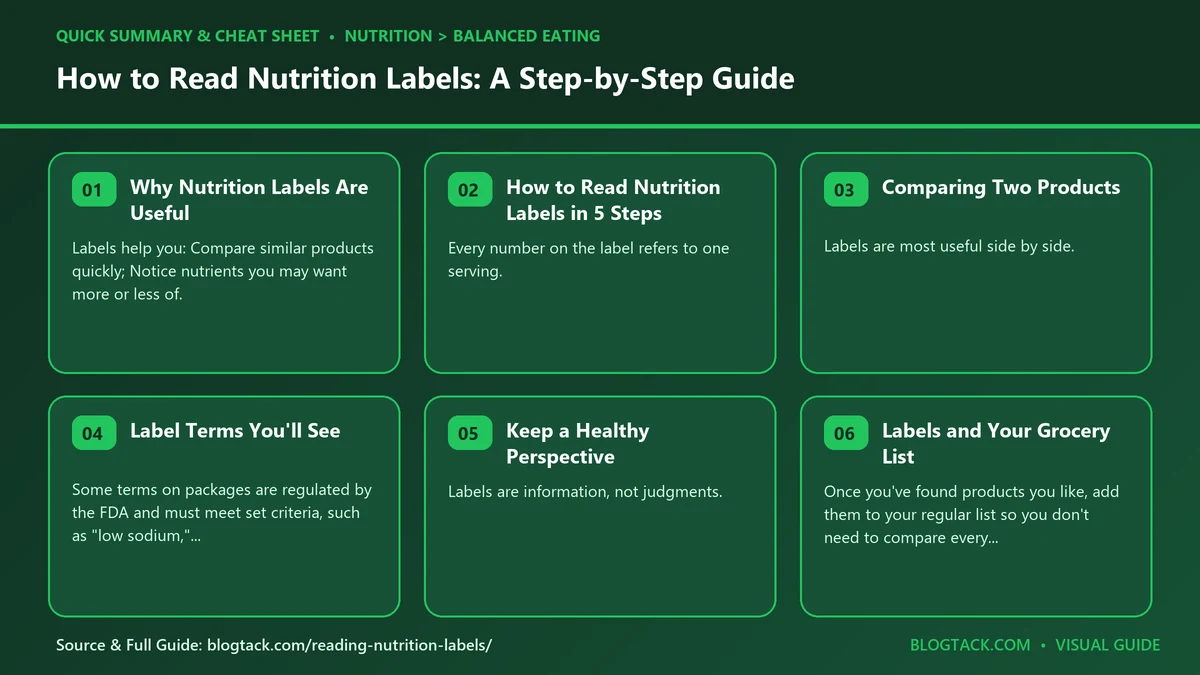
Why Nutrition Labels Are Useful
Labels help you:
- Compare similar products quickly
- Notice nutrients you may want more or less of
- Check ingredients if you have allergies or preferences
- Understand what a serving actually is
They’re one tool among many. Plenty of nourishing foods, like fresh vegetables and fruit, don’t come with labels at all.
How to Read Nutrition Labels in 5 Steps
Step 1: Start With the Serving Size
Every number on the label refers to one serving. The FDA notes that serving sizes reflect amounts people typically eat, not a recommendation of how much you should eat (FDA).
Check servings per container. A package may contain several servings. If you eat more or less than one serving, the amounts change accordingly.
Illustrative example: a bag of crackers lists 2.5 servings per container. If you eat half the bag, you’ve eaten about 1.25 servings.
Step 2: Notice the Energy Line, Then Move On
The label lists energy per serving. It can be useful when comparing similar products, but it’s only one piece of information. Focusing heavily on that number can make eating feel rigid. The nutrients below often tell you more about a food.
Step 3: Use the % Daily Value (%DV)
The %DV shows how much a nutrient in one serving contributes to a total daily diet. The FDA’s general guide:
| %DV per serving | Meaning |
|---|---|
| 5% or less | Low |
| 20% or more | High |
This is often called the 5/20 rule (FDA). You don’t need to calculate anything. Just glance at the percentage.
Step 4: Look at Key Nutrients
The FDA suggests choosing foods more often that are:
| Higher in %DV for | Lower in %DV for |
|---|---|
| Dietary fiber | Saturated fat |
| Vitamin D | Sodium |
| Calcium | Added sugars |
| Iron | |
| Potassium |
A few notes:
- Added sugars are listed separately from total sugars, so you can see how much sugar was added during processing. Natural sugars in fruit and milk are part of total sugars. See how to reduce added sugar.
- Fiber supports digestion and fullness. See why fiber is important.
- Protein, total fat and total carbohydrate are listed too. See what are macronutrients.
Step 5: Read the Ingredient List
Ingredients are listed in order by weight, from most to least. This tells you what the food is mostly made of.
- If whole grains matter to you, look for “whole” (such as “whole wheat flour”) near the start of the list.
- Sugar can appear under many names: cane sugar, syrup, honey, dextrose and others.
- Allergens like milk, eggs, wheat, soy, peanuts, tree nuts, fish, shellfish and sesame must be clearly identified.
Comparing Two Products
Labels are most useful side by side. Make sure serving sizes are similar first.
Illustrative example: two breakfast cereals.
| Per serving | Cereal A | Cereal B |
|---|---|---|
| Dietary fiber | 18% DV | 4% DV |
| Added sugars | 8% DV | 24% DV |
| Sodium | 6% DV | 9% DV |
| First ingredient | Whole grain oats | Corn flour |
Using the 5/20 rule, Cereal A is high in fiber and lower in added sugars; Cereal B is low in fiber and high in added sugars. Both can fit in a varied diet; the label simply helps you choose more often.
Label Terms You’ll See
Some terms on packages are regulated by the FDA and must meet set criteria, such as “low sodium,” “high fiber,” “good source of” and “reduced fat.” Harvard’s Nutrition Source notes that most such terms are regulated and nutrient amounts must meet specific guidelines (Harvard Nutrition Source).
| Term | General meaning |
|---|---|
| High in / Excellent source of | 20% DV or more per serving |
| Good source of | 10 to 19% DV per serving |
| Reduced / Less | At least 25% less than a comparable product |
Other words, like “natural,” are less clearly defined. See food label marketing buzzwords.
Keep a Healthy Perspective
Labels are information, not judgments. A food that’s high in sodium isn’t “bad,” and you don’t need to avoid it. You might simply balance it with lower-sodium choices at other times. The FDA itself suggests making trade-offs across the day.
If reading labels starts to cause anxiety or makes eating feel stressful, step back. Many people eat well without reading labels closely at all.
Labels and Your Grocery List
Once you’ve found products you like, add them to your regular list so you don’t need to compare every time. See how to build a healthy grocery list.
Practical Tips
- Compare two or three options in categories you buy often, like bread, cereal and yogurt, then stick with your choices.
- Check serving size before anything else.
- Focus on a few nutrients that matter to you, not every line.
- Remember fresh produce, eggs and plain grains often have simple labels or none.
Individual Needs Vary
The %DV is based on general reference amounts for adults. Your needs may be higher or lower depending on age, size, activity and health. If you have a condition such as high blood pressure, diabetes or kidney disease, a doctor or registered dietitian can explain which label information matters most for you.
Label Variations
Not every Nutrition Facts panel looks the same:
| Variation | Where you’ll see it | What to know |
|---|---|---|
| Dual-column labels | Packages that could be eaten in one or several sittings | Shows amounts per serving and per package |
| Simplified labels | Foods with few nutrients | Some lines may be missing |
| Small-package labels | Tiny items | May list a phone number or website for details |
| Supplement Facts | Vitamins and supplements | A different format from food labels |
Reading Labels for Allergies and Preferences
If you or someone you cook for has a food allergy, the ingredient list and “Contains” statement matter most. Major allergens must be declared, but “may contain” or “processed in a facility” statements are voluntary and not standardized. When in doubt, contact the manufacturer or ask a doctor or allergist for guidance.
For preferences like vegetarian, halal or kosher, look for recognized certification symbols as well as the ingredient list.
Front-of-Package Information
Beyond the Nutrition Facts panel, the front of many packages carries claims and symbols. Some are regulated; others are marketing. The FDA has also proposed a standardized front-of-package nutrition box to make key information easier to see at a glance. Until rules are finalized, the Nutrition Facts panel on the back remains the most reliable source.
A Two-Minute Label Routine
- Serving size and servings per container (15 seconds)
- Fiber, added sugars and sodium %DV (30 seconds)
- First three ingredients (30 seconds)
- Compare with one alternative (45 seconds)
That’s all most shopping trips need.
Frequently Asked Questions
What’s the most important part of the label?
Start with serving size, then check the %DV for a few nutrients you care about.
What does %DV mean?
It’s the share of a daily reference amount that one serving provides. 5% or less is low; 20% or more is high.
Why are added sugars listed separately?
So you can see how much sugar was added during processing, separately from sugars naturally found in ingredients.
Do I need to read every label?
No. Compare products you buy often, then rely on those choices.
Are “per 100 grams” labels the same?
Some countries use per-100-gram labels instead of per-serving labels. They make side-by-side comparisons easier because the amount is always the same.
Should I avoid foods with long ingredient lists?
Not necessarily. Some long lists include herbs and spices. Look at what the main ingredients are.
What if a food has no label?
Fresh produce, bulk grains and many whole foods don’t need labels. They’re often among the most nourishing choices.
Do restaurant menus have nutrition information?
Larger chains in the U.S. often provide nutrition details on request or online. Smaller restaurants usually don’t.
Are “per serving” amounts the same across brands?
Not always. Two brands may use different serving sizes, so check before comparing numbers.
Can labels help with food allergies?
Yes. Check the ingredient list and “Contains” statement every time, since recipes can change.
The Bottom Line
How to read nutrition labels: check the serving size, use the 5/20 rule for %DV, look at fiber, added sugars, sodium and a few other key nutrients, read the ingredient list and compare similar products. Treat labels as a helpful tool, not a set of rules, and seek personal guidance if you have specific health needs.
This article is for general informational and educational purposes only and is not medical, nutritional, or dietary advice. Individual nutritional needs vary. Consult a doctor or registered dietitian for personalized guidance, especially if you have any health conditions or specific dietary needs.