“Self-care” has become a marketing word. It’s often shown as bubble baths, face masks and expensive retreats. Those things are fine if you enjoy them, but real self-care is usually less glamorous: going to bed on time, eating something nourishing, saying no to one more commitment, calling a friend.
This guide explains how to build a self-care routine that fits your actual life, with a simple plan, sample routines and a reminder of when self-care isn’t enough on its own.
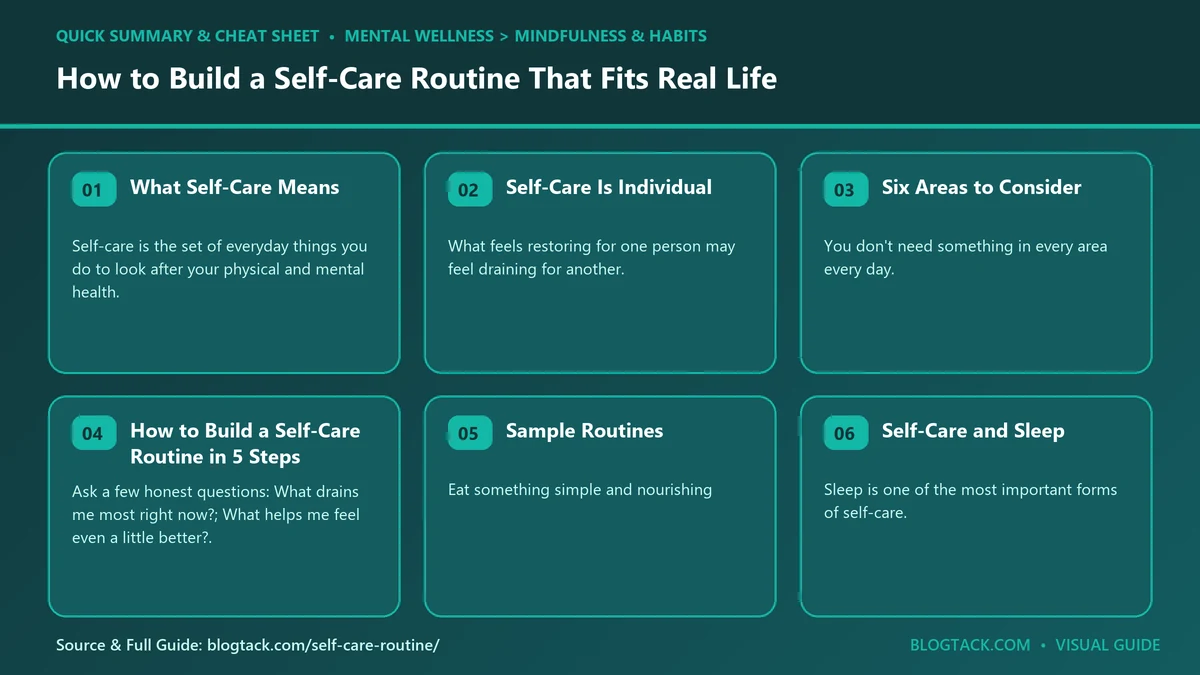
What Self-Care Means
Self-care is the set of everyday things you do to look after your physical and mental health. It’s not a reward you earn, and it’s not selfish. It’s maintenance, like charging your phone.
The American Psychological Association describes self-care as a legitimate practice for mental health and building resilience, noting that stress is as much physical as emotional (APA).
Self-Care Is Individual
What feels restoring for one person may feel draining for another. An introvert may recharge with a quiet evening; an extrovert may feel better after dinner with friends. There’s no right list. The aim is to find what helps you.
Six Areas to Consider
| Area | What it covers | Everyday examples |
|---|---|---|
| Physical | Sleep, movement, food, medical care | Regular bedtime, a daily walk, drinking water, keeping health appointments |
| Emotional | Noticing and processing feelings | Journaling, talking things through, allowing yourself to feel |
| Mental | Rest for your mind, learning, focus | Screen breaks, reading for pleasure, a puzzle |
| Social | Connection with others | Calling a friend, a regular coffee date, joining a group |
| Practical | Keeping daily life manageable | Planning meals, sorting bills, tidying one area |
| Rest and enjoyment | Doing things just because you like them | A hobby, music, time outdoors |
You don’t need something in every area every day. Over a week, try to touch most of them.
How to Build a Self-Care Routine in 5 Steps
Step 1: Check In With Yourself
Ask a few honest questions:
- What drains me most right now?
- What helps me feel even a little better?
- Which area above have I been neglecting?
- How much time and energy do I realistically have?
Step 2: Pick Two or Three Small Practices
Choose practices that are small enough to do even on a busy day. Examples:
- Ten minutes outside after lunch
- Phone away 30 minutes before bed
- A glass of water with breakfast
- One message to a friend each day
- Five minutes of writing in the evening
For more ideas, see habits for mental wellness.
Step 3: Anchor Them to Your Day
Link each practice to something you already do. “After I close my laptop, I’ll step outside for ten minutes.” Clear cues make new routines much easier to keep, as our guide on building better mental habits explains.
Step 4: Protect the Time
Self-care often gets pushed aside by everything else. A few ways to protect it:
- Put it in your calendar like any other appointment.
- Say no to one non-essential request a week. See how to set healthy boundaries.
- Lower the bar on busy days; a two-minute version still counts.
Step 5: Review and Adjust
After two or three weeks, notice what’s working. Keep what helps, drop what doesn’t, and add something new if you have room.
Sample Routines
A Busy Weekday
| Time | Practice |
|---|---|
| Morning | Glass of water, three slow breaths, open curtains for daylight |
| Midday | Ten-minute walk without your phone |
| Evening | Phone on charger outside the bedroom; read for 10 minutes |
A Low-Energy Day
- Eat something simple and nourishing
- Shower or wash your face
- Sit by a window or step outside for a few minutes
- Text one person
- Go to bed a little earlier
A Weekend Reset
- Sleep in a little, but keep wake time close to usual
- Longer walk or time in nature
- Plan meals for the week to take daily food stress off your plate
- Something just for fun
- Time with people you care about
These are examples, not rules. Build your own from what works for you. For mornings specifically, see a morning routine for mental wellness.
Self-Care and Sleep
Sleep is one of the most important forms of self-care. A CDC report notes that sleep experts recommend at least 7 hours a night for adults aged 18 to 60 (CDC). See sleep and mental wellness for ideas on supporting rest.
Self-Care and Screens
Screens can be relaxing, but they can also crowd out rest and connection. Small limits, like no phone in the first 30 minutes after waking, can free up time and attention. See the benefits of a digital detox.
Self-Care Isn’t Selfish
Many people feel guilty taking time for themselves, especially caregivers and parents. But looking after yourself makes it easier to be present for others. You can’t pour from an empty cup is a cliché because it’s true.
Common Obstacles
| Obstacle | Try this |
|---|---|
| “I don’t have time.” | Start with a two-minute practice |
| “It feels indulgent.” | Remember self-care includes basics like sleep and food |
| “I forget.” | Anchor it to an existing habit or set a reminder |
| “I start and stop.” | Expect gaps; restart without judgment |
| “Nothing seems to help.” | This may be a sign to reach out for professional support |
When Self-Care Isn’t Enough
Self-care supports wellbeing, but it can’t fix everything. It isn’t a substitute for therapy, medical care or support during a crisis. Consider talking to a doctor or mental health professional if:
- You’ve felt low, anxious or numb most days for two weeks or more
- Daily tasks feel overwhelming
- You’re withdrawing from people and activities you used to enjoy
- You’re using alcohol or other substances to cope
The National Institute of Mental Health offers guidance on finding help (NIMH). If you’re in crisis, contact a local crisis line or emergency services; in the U.S., call or text 988.
A Weekly Self-Care Check
At the end of each week, take five minutes to rate each area from 1 (neglected) to 5 (well looked after):
| Area | Score (1 to 5) | One small step for next week |
|---|---|---|
| Physical | ||
| Emotional | ||
| Mental | ||
| Social | ||
| Practical | ||
| Rest and enjoyment |
You don’t need high scores everywhere. The point is to notice which area needs a little attention and choose one small step for it.
Self-Care for Caregivers and Parents
If you look after others, your own needs can slip to the bottom of the list. Some ideas that fit around caregiving:
- Use short windows, like five minutes with a cup of tea before others wake up.
- Swap time with another caregiver or family member so each of you gets a break.
- Accept offers of help, even small ones.
- Look for local caregiver support groups.
Looking after yourself isn’t a luxury when others depend on you. It’s part of being able to keep going.
Self-Care on a Tight Budget
Most self-care costs nothing. A walk in a park, a library book, a free online yoga class, an early night, a phone call with a friend, cooking a simple meal at home, sitting outside in the sun. If you notice that self-care ideas you see online always involve spending money, it’s worth remembering that the most helpful practices are usually the simplest ones. Start with what’s free and within reach.
Frequently Asked Questions
How long does a self-care routine need to be?
It can be just a few minutes a day. Consistency matters more than length.
What if I can’t afford self-care?
Most self-care is free: sleep, walking, time outdoors, talking with friends, writing.
Should my routine be the same every day?
A few anchor practices help, but it’s fine to flex depending on your energy and schedule.
Is self-care the same as treatment?
No. Self-care supports everyday wellbeing. Treatment from a qualified professional is different and important when needed.
What if self-care feels like another chore?
Choose fewer, simpler practices and pick ones you actually enjoy. Self-care should lighten your load, not add to it.
Can self-care include saying no?
Yes. Protecting your time and energy is one of the most useful forms of self-care.
How do I keep going when life gets busy?
Keep one or two tiny practices you never skip, even on the busiest days, and return to the rest when things settle.
Is it OK if my routine looks different from other people’s?
Yes. The best routine is the one that fits your needs, energy and circumstances.
The Bottom Line
To build a self-care routine that lasts, check in with what you need, choose two or three small practices across different areas of life, anchor them to your day, protect the time and adjust as you go. Keep it simple and kind. And when self-care isn’t enough, reaching out for professional help is part of taking care of yourself too.
This article is for general informational and educational purposes only and is not medical advice, therapy, or a substitute for professional mental health care. If you are struggling with your mental health, please reach out to a qualified mental health professional. If you are in crisis, contact a local crisis line or emergency services.